
 Business License

Best Mower for Hills and Uneven Terrain: What Actually Works on Bumpy, Sloped Ground
In April 2024, Marcus Chen bought a zero-turn mower for his seven-acre property outside Asheville, North Carolina. The land rolled gently, nothing steeper than 20 degrees, but the ground was a mess of tree roots, old fence posts, and gopher holes left by decades of pasture use. On the third cut, the left front wheel dropped into a hidden rut, the deck scalped a four-inch trench across the lawn, and the impact bent a blade spindle. The repair bill was $340. The grass looked worse than before he started.
Hills are only half the problem. Uneven terrain --- ruts, rocks, exposed roots, and soft patches --- adds a second layer of difficulty that slope ratings alone do not capture. A mower can be rated for 15 degrees and still fail on bumpy ground because its wheels lose contact, its deck tilts, or its chassis bottoms out. The best mower for hills and uneven terrain must handle both the angle and the irregular surface underneath.
This article explains what makes terrain truly uneven, why standard mowers struggle on bumpy slopes, and what specifications separate machines that merely survive rough ground from machines that cut cleanly across it. You will see a comparison of every common mower type on uneven terrain, a framework for evaluating ground clearance and suspension, and a clear recommendation for the one category that handles both hills and bumps without putting the operator at risk.
Looking for a mower that handles both hills and rough ground? Browse the Vigorun remote mower lineup and compare track-based models built for uneven terrain.
What "Uneven Terrain" Actually Means for Mowing
Uneven terrain is not the same as steep terrain. A slope can be perfectly smooth --- a manicured golf fairway, a dam face graded to spec --- and still be steep. Uneven terrain is irregular. It has vertical variation within a small footprint. The ground goes up and down faster than the mower deck can follow.
Common uneven terrain features:
Exposed tree roots that lift the deck on one side and drop it on the other
Gopher holes, mole runs, and livestock ruts that catch wheels and tilt the chassis
Rock outcroppings and construction debris that limit ground clearance
Soft patches and erosion channels where wheels sink and lose traction
Terracing transitions where flat meets slope in abrupt steps
A ride-on rotary mower with a 48-inch deck needs relatively flat ground to maintain an even cut. The deck hangs from the chassis on linkage arms. If one wheel drops three inches into a rut, that side of the deck drops with it. The result is a scalped stripe on one side and uncut grass on the other. On a slope, that unevenness is magnified because gravity pulls the chassis downhill while the rut pulls one corner down further.
The Bureau of Labor Statistics tracks landscaping injuries, and a significant share involves not just slope rollovers but also equipment instability on irregular ground. A wheel dropping into a hidden hole at mowing speed can throw an operator off a ride-on unit or snap a walk-behind handle back into the operator's body.
Want help measuring both slope and surface irregularity? Read our guide on how to choose a slope mower for terrain-specific selection criteria.
Why Traditional Mowers Fail on Hills Plus Bumps
Most mower categories were designed for flat, manicured turf. When you add both slope and surface irregularity, their weaknesses compound.
Ride-On Rotary Mowers
Slope limit: 15 degrees on smooth grass
Uneven terrain limit: Minimal --- low ground clearance, rigid deck linkage, and large turning radius
Failure mode: Wheels drop into ruts, deck scalps high spots, rollover risk increases on side slopes with uneven footing
Zero-Turn Mowers
Slope limit: 10 to 15 degrees depending on tire width
Uneven terrain limit: Rear caster wheels snag on roots and ruts; lap-bar steering offers no suspension feedback
Failure mode: Caster wheels pivot into holes, causing sudden stops or directional snaps that stress the operator's arms and back
Walk-Behind Mowers
Slope limit: 15 to 20 degrees
Uneven terrain limit: The operator's arms become the suspension; every bump transmits through the handle
Failure mode: Operator fatigue, loss of control on roots, and repeated lifting over obstacles
Self-Propelled and All-Wheel-Drive Push Mowers
Slope limit: 15 degrees
Uneven terrain limit: Better than standard push mowers, but still limited by small wheels and no deck float
Failure mode: Wheels spin on loose patches between roots; deck hangs up on high spots
Robotic Mowers
Slope limit: 20 to 30 degrees on premium models
Uneven terrain limit: Boundary wire must follow terrain; wheels are small and often solid-rubber
Failure mode: Gets stuck on roots, cannot navigate ruts, and requires extensive site prep before deployment
The pattern is consistent. Wheeled mowers need smooth ground. When the ground is not smooth, the wheels --- not the operator --- decide where the deck goes. On a slope, that loss of control becomes dangerous.
What the Best Mower for Hills and Uneven Terrain Must Deliver
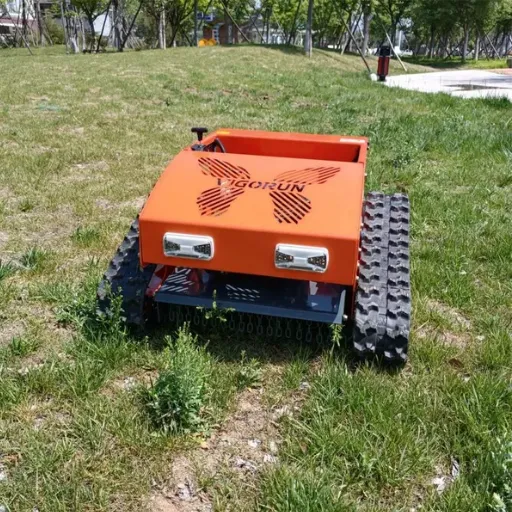
A mower that handles both hills and bumps needs four capabilities that most machines do not have.
1. Continuous Ground Contact Without Wheel Dependence
The deck must follow the ground contour independently of the wheels. On uneven terrain, individual wheels rise and fall over roots and ruts. If the deck is rigidly attached to the wheel chassis, it rises and falls with them. The best mower for hills and uneven terrain uses a deck with anti-scalp rollers, independent suspension, or a tracked chassis that distributes weight across a long footprint so no single root or rut tilts the entire machine.
2. High Ground Clearance and Protected Undercarriage
Exposed roots, rocks, and stump remnants sit above the soil line. A deck that rides two inches off the ground will strike them. Look for ground clearance of 100 millimeters or more, with skid plates or reinforced deck edges that can brush against obstacles without damage.
3. Traction on Loose and Variable Surfaces
Wet clay, loose soil, and gravel patches are common on uneven ground. Wheels compact and then spin. Rubber tracks with aggressive lug patterns distribute weight over a larger area and bite into soft or loose terrain without sinking. A hydrostatic transmission maintains torque at low speed, which is exactly what rough ground demands.
4. Operator Safety Distance
On uneven slopes, the operator is at risk from two directions: the slope itself and the machine's reaction to bumps. A remote-controlled mower removes the operator from both. The operator stands on flat, stable ground up to 200 meters away while the machine handles the unpredictable terrain.
Remote-Controlled Tracked Mowers vs. Wheeled Mowers on Rough Ground
The comparison is not close. A tracked remote mower was engineered for terrain that wheeled mowers cannot safely access.
| Factor | Ride-On Mower | Walk-Behind | Robotic Mower | Tracked Remote Mower |
|---|---|---|---|---|
| Max slope (smooth) | 15 degrees | 20 degrees | 25 degrees | 45 degrees |
| Uneven terrain handling | Poor | Poor to fair | Fair | Excellent |
| Ground clearance | 50-80 mm | 40-60 mm | 50-70 mm | 100+ mm |
| Operator position | On machine | On slope | N/A | 200 m away |
| Root and rock tolerance | Low | Low | Low | High |
| Deck float / anti-scalp | Basic | Basic | None | Advanced rollers |
| Daily production (rough terrain) | 0.5-1 acre | 0.3-0.6 acre | N/A (boundary limited) | 2-4 acres |
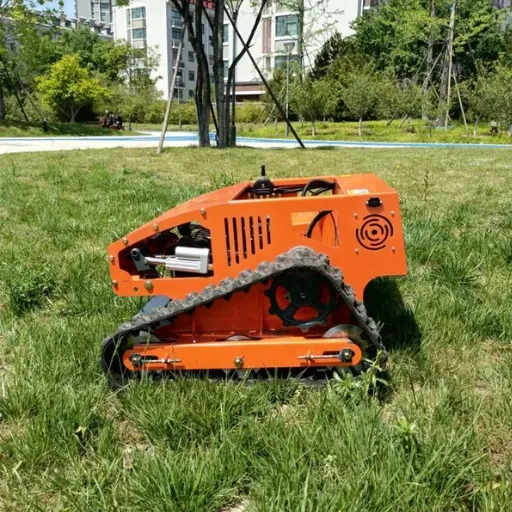
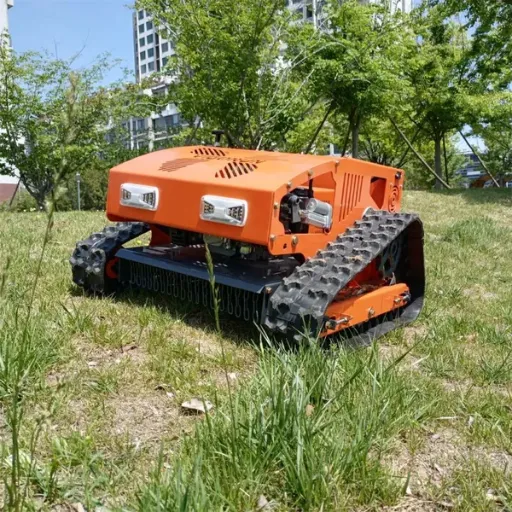
The tracked chassis is the critical difference. Rubber tracks conform to surface irregularities instead of bridging over them like wheels. A 180-millimeter-wide track wraps over a root where a wheel would stop or bounce. The low center of gravity keeps the machine stable even when one track climbs a bump while the other stays in a depression.
For property owners with bumpy, sloped land, that means the mower cuts where no ride-on or walk-behind unit can operate without damage or danger. For landscaping contractors, it means bidding jobs that competitors decline because their wheeled fleets cannot handle the ground.
Key Specs to Demand in a Mower for Hills and Uneven Terrain
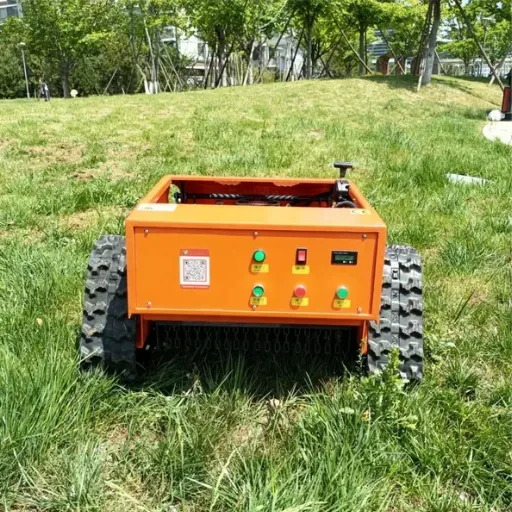
When you evaluate equipment for rough, sloped ground, five specifications matter more than engine horsepower or cutting width.
1. Track Width and Tread Pattern
Rubber tracks outperform wheels on uneven terrain because they distribute weight and maintain grip across surface changes. Look for track width of 180 millimeters or more, with deep lug tread that bites into loose soil and climbs over roots without slipping. Smooth or narrow tracks offer no advantage over wheels.
2. Ground Clearance and Deck Protection
Measure from the lowest point of the deck to the ground in the highest cutting position. Anything under 80 millimeters will strike roots and rocks regularly. The Vigorun VTLM800 carries a reinforced deck with anti-scalp rollers that ride on the turf while the blades stay at a consistent height above the high spots.
3. Deck Float and Cutting Height Range
A fixed deck cannot follow ground contour. Look for a deck with multiple cutting height positions --- typically 20 to 80 millimeters --- and linkage that lets the deck tilt slightly to match slope angle without scalping. On uneven terrain, the ability to raise the deck for a first rough cut and then lower it for a finish pass prevents damage and improves results.
4. Engine Slope Rating
Standard lawn mower engines use sump lubrication that fails when the machine tilts on a slope for more than a few seconds. A slope-rated engine maintains oil pressure at angles up to 45 degrees. Without that rating, a bumpy hillside will destroy the engine even if the chassis survives.
5. Remote Control Range and Failsafes
A 200-meter control range covers most residential and commercial jobs in line-of-sight. On uneven terrain, the failsafe matters more than the range. If the signal drops because the machine dips behind a rise, the blade stops and the chassis halts automatically. Verify hardware emergency stops on both the transmitter and the chassis.
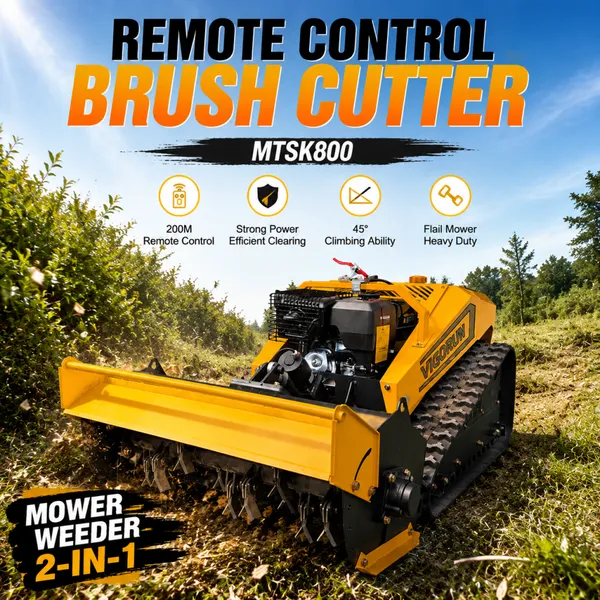
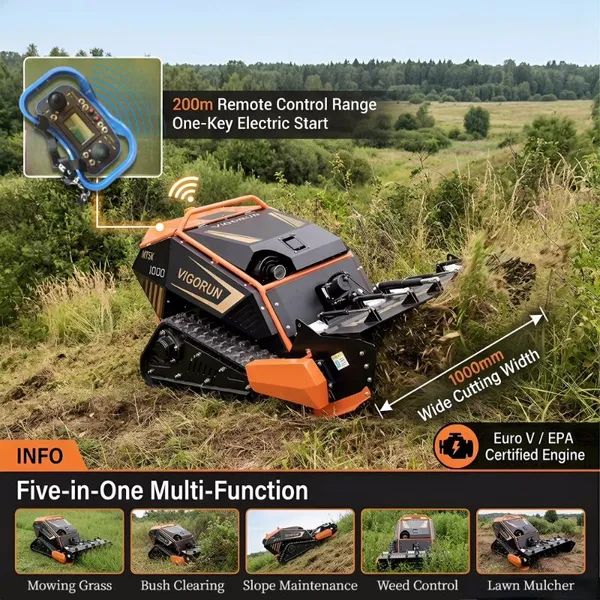
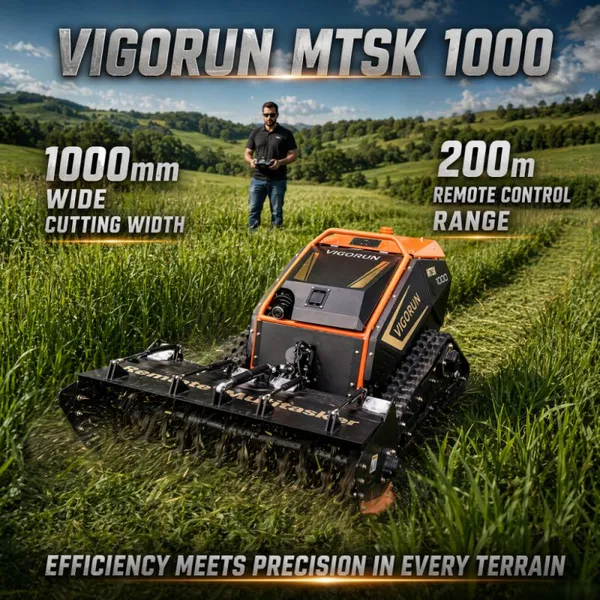
The MTSK1000 remote flail mower adds a sixth advantage for rough ground: a flail head that mulches woody brush, saplings, and overgrown vegetation up to 25 millimeters thick --- the kind of regrowth that often hides holes and debris on neglected hillside properties.
Real-World Applications: Estates, Orchards, Pastures, and Rough Lawns
The best mower for hills and uneven terrain is not a theoretical category. It solves specific problems on real properties.
Rural Estates and Acreage Properties
Large private properties often combine rolling hills with unmaintained pasture, old fence lines, and wooded edges. A ride-on mower cannot navigate the transitions. A tracked remote mower cuts the open lawn, the rough edges, and the sloped drainage swales with the same machine. The operator stands on the porch or the flat driveway, controlling the machine across ground that would wreck a conventional deck.
Orchards and Vineyards on Rough Ground
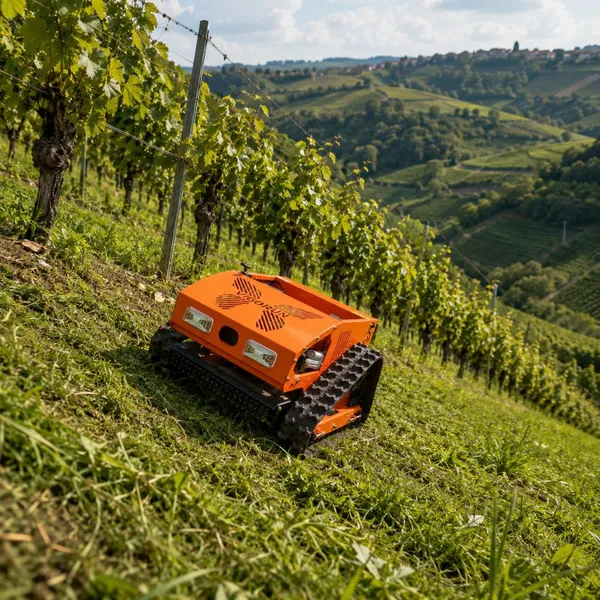
Fruit and wine operations on hillsides face between-row ground that is rarely graded smooth. Irrigation ruts, tractor compaction, and erosion channels create constant surface variation. A tracked remote mower follows the contour between rows without damaging trunks, while the operator stands on the access path.
Recreational Land and Hunting Properties
Food plots, trail edges, and cabin clearings on recreational land are typically cut once per month during growing season. The ground is uneven, the vegetation is mixed grass and brush, and the nearest repair shop is an hour away. A tracked machine with interchangeable cutting heads handles both the grass and the brush, and its robust undercarriage survives contact with rocks and stumps that would disable a wheeled mower.
Sloped Residential Lots with Poor Grading
Suburban and rural residential lots on hills often suffer from builder grading that left swales, compaction ruts, and drainage channels. The slope is moderate --- 15 to 25 degrees --- but the surface is bumpy enough to make a zero-turn unusable. Homeowners in this situation typically hire crews with string trimmers or resign themselves to patchy results. A remote-controlled mower cuts cleanly without the operator ever setting foot on the slope.
In 2023, a landscaping contractor named Elena Voss bid maintenance for a 12-acre estate in Virginia's Shenandoah Valley. The property had been a cattle farm for 40 years before conversion to a private residence. The ground was riddled with hoof ruts, drainage ditches, and exposed limestone. Three other contractors had declined the job because their ride-on fleets could not handle the surface.
Elena spec'd a tracked remote mower with a 45-degree slope rating and a flail head. The first cut took four hours. The client signed an annual contract. By the third cut, the flail head had mulched the brush and sapling regrowth enough that Elena switched to the rotary deck for a cleaner finish. She added two more rough-ground estate clients that same season --- jobs her competitors could not bid because their equipment was limited to smooth turf.
The Hidden Costs of the Wrong Mower on Rough Ground
Using a smooth-ground mower on uneven terrain generates costs that do not show up in the purchase price.
Deck and Blade Damage
Every root strike, rock hit, and rut impact transfers energy into the deck shell, the spindle bearings, and the blade bolts. A residential zero-turn deck is not built for that abuse. Replacement spindles run 80to80to150 each. A bent deck shell costs 400to400to800 to repair or replace. Over two seasons on rough ground, repair bills often exceed 30 percent of the machine's original value.
Operator Injury and Fatigue
Walk-behind mowers on bumpy ground vibrate through the operator's hands, wrists, and shoulders. The Bureau of Labor Statistics records repetitive stress and acute impact injuries among grounds maintenance workers at rates well above the national average. Ride-on operators risk jolts that compress the spine and sudden stops that throw them against the steering wheel or roll bar.
Poor Cutting Quality
Uneven cuts require re-cutting. A scalp mark across a visible lawn means the crew must return, often with a string trimmer or a different machine, to blend the damage. That rework destroys job profitability and customer satisfaction.
Missed Revenue Opportunities
Contractors with smooth-ground fleets must decline rough-terrain contracts. Every declined bid is revenue that goes to a competitor --- or to no one, leaving the client unserved. A mower for hills and uneven terrain opens a service category that most landscapers cannot handle.
How to Choose the Best Mower for Hills and Uneven Terrain
Selecting equipment for rough, sloped ground means testing the machine against your worst section of property, not your best.
Step 1: Walk the Property and Mark Obstacles
Walk every area you need to cut. Mark exposed roots, rocks, ruts, and soft patches. Measure the steepest slope with a clinometer app. If the slope exceeds 15 degrees or the surface has more than a few inches of vertical variation, a ride-on or standard walk-behind machine is a liability.
Step 2: Match the Cutting System to the Vegetation
Grass-only properties need a rotary deck. Mixed grass-and-brush properties, or land that has been neglected for a season, need a flail head for the first pass. If you maintain both, choose a platform with interchangeable attachments.
Step 3: Verify Ground Clearance and Track Specs
Ask the supplier for ground clearance numbers and track dimensions. Photos and videos on smooth turf mean nothing. Request footage of the machine cutting on rutted or rocky ground. If the supplier cannot provide it, the machine has not been tested on uneven terrain.
Step 4: Confirm Engine and Emission Certification
If you operate in the EU, USA, Canada, or Australia, demand CE, EPA, and EURO V documentation with the quote. Rough-ground mowing is hard on engines; you need warranty support and parts availability, which only come from certified suppliers with stable operations.
Step 5: Evaluate the Supplier's Support Capacity
Uneven terrain breaks wear parts faster than smooth turf. You need a supplier who stocks blades, tracks, sprockets, and engine components, and who can ship by air freight when something breaks mid-season. Ask about warranty terms, parts availability, and after-sales support before comparing prices.
Vigorun builds every unit in a Weifang facility with a dedicated quality control team and 100 percent indoor and outdoor field testing before shipment. Distributors get OEM color, logo, and packaging options starting at 5 units, with whole-life parts support on every machine sold.
Conclusion
The best mower for hills and uneven terrain is not the one with the widest deck or the highest horsepower. It is the one that keeps the deck level, the operator safe, and the machine intact when the ground beneath it is neither level nor smooth.
A tracked remote mower with a low center of gravity, 100-plus millimeters of ground clearance, anti-scalp rollers, and a 200-meter wireless range handles both the slope and the bumps that disable wheeled machines. It climbs hills no ride-on can attempt safely. It rides over roots and ruts that would scalp a standard deck. And it keeps the operator on flat, stable ground while the machine does the dangerous work.
If your property or your contract portfolio includes sloped, bumpy, rutted, or irregular ground, the right equipment is not an upgrade. It is the difference between cutting the grass and damaging the machine, the lawn, or the operator.
Ready to spec a mower for hills and uneven terrain that climbs 45-degree slopes and rides over roots while your operator stands safely on flat ground? Request a quote for FOB Shandong pricing, or ask about OEM branding for your distributor catalog. We will send spec sheets, container-loading diagrams, and certification documentation within 24 hours.
Recently Posted
-
Steep Slope 600mm Tracked 200m Remote Control 45 Degree Brushless Electric Lawn Mower
August 10, 2026*Integrated Drive System with 73 Percent Efficiency: The VTLM600 remote control lawn mower features a fully integrated brushless m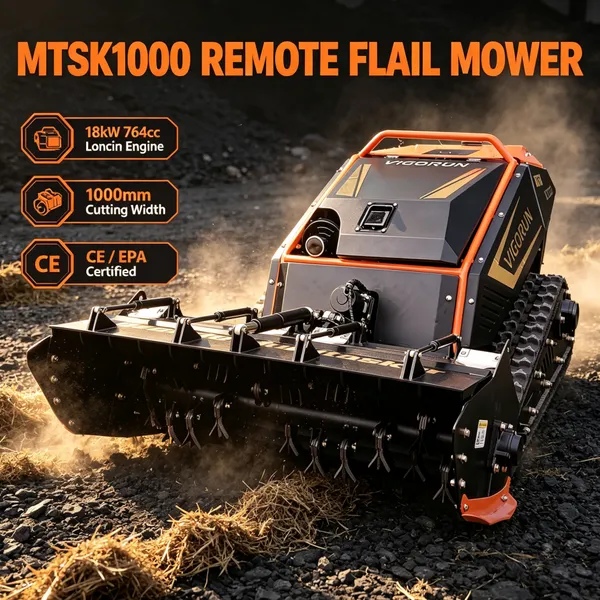 Read More
 -
Remote Controlled Pesticide Sprayer with 600L Tank 8.4m Boom for Agricultural Applications
August 10, 2026*Electric Start & 13kW Loncin Engine for Powerful Agricultural Spraying: Maximize field application efficiency with the SPRY60 Read More
 -
Self Propelled Agricultural Boom Sprayer with Adjustable Track for Modern Farming
August 10, 2026*Electric Start & 13kW Loncin Engine for Powerful Agricultural Spraying: Maximize field application efficiency with the SPRY60 Read More
 -
Automatic Remote Control Agricultural Spray Machine with 600L Chemical Tank and Boom System
August 10, 2026*Electric Start & 13kW Loncin Engine for Powerful Agricultural Spraying: Maximize field application efficiency with the SPRY60 Read More

Contact Us
Recommended Products
-
 Vigorun Lawn Mower Robot, Industrial Dual 48V 1500W Motors MTSK1000 Mulcher Machine for Large LandscapesUS$ 7500.00 - 7700.00MOQ: 1 Set
 -
Farmland Orchards Battery Powered Mower Gasoline Golf Mower Robot Lawn Mower 3000m2 Vigorun Remote Control Grass MowerUS$ 2580 - 2700MOQ: 1 Unit
-
Vigorun MTSK800 Automatic Remote Control Grass Cutting Machine 48V 20Ah Battery Remote Flail MowerUS$ 2800 - 2900MOQ: 1 Set
-
Vigorun MTSK1000 Remote Control Mower 24hp Fail-Safe Slope Braking Remote Control Forest MulcherUS$ 8000 - 8200MOQ: 1 Set
-
Industry Electric Motor Lawn Mower Flail Mower Atv Gasoline Hedge Trimmer Battery LawnmowerUS$ 2580 - 2900MOQ: 1 Unit
-
Vigorun Agricultural Tractor Sprayer Euro 5/EPA Electric Agricultural Sprayer 600l for VineyardsUS$ 2600 - 2700MOQ: 1 Set
-
Remote Control Tracked Hillside Mower 800mm Cutting Width 60 Degree Slope for Steep Terrain VegetationUS$ 2600 - 2700MOQ: 1 Set
-
Vigorun VTLM600 RC Lawn Mower Robot CE EPA Certified 45° Extreme Slope Mini Crawler Lawn MowerUS$ 1700 - 17900MOQ: 1 Set
-
Remote Controlled High Efficiency Fog Cannon Spraying Machine 600L Tank for Agriculture and Dust ControlUS$ 2800 - 2900MOQ: 1 Set
-
Vigorun Radio Control Mowing Euro 5/EPA Self-Propelled & Precise 6hp Remote Control Crawler MowerUS$ 1700 - 1790MOQ: 1 Set
-
Factory Manufacturer Vigorun MTSK1000 1000MM Commercial Branch Cutter Flail Mower rc Remote Petrol Lawnmower Mower Grass Cutter TractorUS$ 8000 - 8200MOQ: 1 Set
-
Vigorun VTW550 Remote Control Grass Cutter Tractor Robot Gas Lawn Mower Grass Cutter Small Electric Lawn Mower Vigorun Lawn MowerUS$ 1000 - 1250MOQ: 1 Set
-
Vigorun Tech Gasoline Remote Control Lawn Mower Self-Locking Slope Safety RC Mower Tiller for EmbankmentsUS$ 2800.00 - 2900.00MOQ: 1 Set
-
Mower Gasoline Grass Cutter Machine Remote Control 1000mm Cut 35 Degree Slope Flail Hammer for Overgrown LandUS$ 7500 - 7700MOQ: 1 Set
-
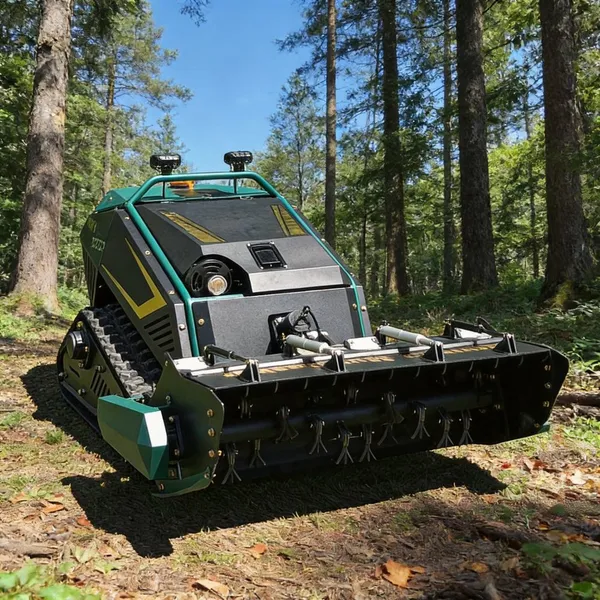
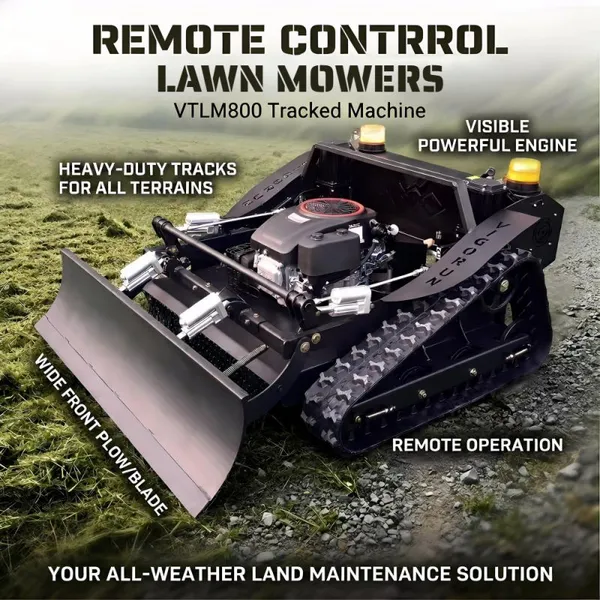
Vigorun VTLM800 Remote Control Electric Mower, Self-Locking Slope Safety Crawler Mower for Steep SlopesUS$ 2600.00 - 2700.00MOQ: 1 Set
-
Shrub and Brush Clearing MTSK800 MTSK1000 Flail Mower rc Remote Weeding Weeder MachineUS$ 2800 - 2900MOQ: 1 Set
-
RC Robot Lawn Mower Electric Remote Control Flail Grass Cutter Garden Cutting Machine MTSK1000US$ 8000 - 8200MOQ: 1 Set
-
Remote Manipulation Rubber Track Brush Cutter Industrial Flail Mower for Efficient Shrub ClearingUS$ 2000.00 - 2790.00MOQ: 1 Set
-
Vigorun MTSK1000 Rc Lawn Mower, Loncin 764CC Gasoline Engine Forestry Mulcher With Remote Control for ForestryUS$ 7500.00 - 7700.00MOQ: 1 Set
-
Vigorun VTC550 Zero Turn Electric Mower Quality Guaranteed Crawler Brush Cutter For Embankments & LeveesUS$ 1600 - 1690MOQ: 1 Set