
 Business License

Gasoline Remote Control Lawn Mower: Why Batteries Quit Before the Job Ends
Marcus Chen's crew was two hours into clearing a five-hectare solar farm easement when the first battery mower died. It was 11:30 a.m. The second unit followed at 1:15 p.m. By 2:00 p.m., three lithium packs were stacked on the tailgate, charging from a generator that burned more diesel than the mowers saved.
That afternoon cost him four hours and a late penalty. The battery machines were excellent on flat villa lawns. They were the wrong tool for a commercial clearing contract.
A gasoline remote control lawn mower does not run out of electrons. It runs on fuel you can pour in thirty seconds. For large properties, steep terrain, and thick vegetation, the internal combustion engine is still the only power source that delivers sustained torque, all-day runtime, and field-refuel capability. This guide explains engine options, emissions compliance, fuel logistics, and the operating economics that make gasoline the practical choice for professionals.
Want to understand how slope angles affect engine load? Our guide on how steep a slope a remote control mower can climb breaks down the physics of hillside cutting and why torque matters more than horsepower on inclines.
Why a Gasoline Remote Control Lawn Mower Beats Battery on Large Jobs

The Battery Runtime Wall
Battery remote mowers have made genuine progress. Modern lithium packs deliver forty to sixty minutes of cutting time on flat grass. That is enough for a suburban garden or a small orchard block.
It is not enough for a levee face, a dam embankment, or a commercial brush-clearing contract. When the battery hits twenty percent, the operator must stop, remove the pack, and wait. Even fast-charge cycles take forty-five minutes. During that downtime, the crew is idle and the meter is running.
A gasoline remote control lawn mower carries enough fuel for three to five hours of continuous operation. Refueling takes less than a minute. There is no charger infrastructure to transport, no battery degradation to track, and no mid-afternoon shutdown.
Power-to-Weight on Hills and Thick Brush
Gasoline engines produce torque across a broad RPM range. A 452cc single-cylinder unit delivers peak torque at 2,500 RPM. It does not sag when the grass gets thick or the slope steepens.
Battery mowers compensate with larger electric motors. But motor torque is limited by battery discharge rate. Under sustained heavy load, the controller throttles output to protect the cells. The cut quality drops. The operator notices immediately.
On a 35-degree slope with waist-high brush, the difference is not marginal. It is the difference between finishing the job and driving back to swap batteries.
Gasoline Remote Control Lawn Mower Engine Options Explained
Single-Cylinder vs. V-Twin Configurations
Most commercial gasoline remote mowers use single-cylinder air-cooled engines in the 200cc to 500cc range. Single-cylinder designs are lighter, simpler, and easier to service in the field. They produce ample torque for rotary and flail decks up to 1,000 millimeters wide.
V-twin engines appear on the largest units, typically above 600cc. The twin configuration runs smoother, generates more horsepower, and handles heavy flail heads or mulching attachments with less vibration. The trade-off is weight and parts cost. A V-twin adds roughly fifteen kilograms to the chassis. That matters on transport and on soft ground.
Vigorun Tech's gasoline-powered lineup uses single-cylinder engines from 224cc to 452cc. The 452cc variant, fitted to the VTJ800 brush mower, outputs 16 horsepower and drives a 1,000-millimeter flail head through brush up to 40 millimeters in diameter. For distributor fleets, engine size is matched to the application at the factory. A levee maintenance contractor does not need the same motor as a forestry clearing crew.
Displacement, Torque, and Cutting Deck Matching
Engine displacement determines how much air and fuel the cylinder can process. More displacement means more torque. But bigger is not always better.
A 224cc engine paired with a 550-millimeter rotary deck is ideal for grass and light brush on slopes up to 30 degrees. It is fuel-efficient and light. A 452cc engine with a flail head is built for thick vegetation and commercial duty cycles. Matching the engine to the deck prevents lugging, overheating, and premature wear.
The spec sheet to request from any supplier should list:
Engine displacement and rated horsepower
Peak torque RPM
Recommended deck sizes
Fuel consumption per hour at rated load
If the supplier cannot provide fuel consumption data, they have not tested the machine under load. Move on.
Emissions Compliance: EURO V, EPA, and What They Mean for Buyers
Certification Labels and Import Requirements
Emissions rules are not optional decoration. They are import gatekeepers. A gasoline remote control lawn mower shipped into the European Union must meet EURO V standards for non-road mobile machinery. In the United States, the Environmental Protection Agency requires compliance with Phase 3 exhaust emission standards.
Non-compliant machines are detained at customs. The buyer pays storage fees while the supplier scrambles for paperwork that may not exist. This happens more often than buyers expect, especially with units sourced through trading companies that assemble machines from generic parts.
Factory-Direct Compliance Documentation
Vigorun Tech builds engines with EURO V and EPA certification from the factory. Every gasoline remote mower ships with the emissions compliance label affixed to the engine block and the certificate included in the documentation packet. Distributors who need customs clearance receive a scanned copy before the container leaves Qingdao.
Elena Kowalski, a equipment distributor in Hamburg, learned this the hard way. In 2022 she imported a container of remote mowers from a trading company in Guangdong. The engines lacked EURO V labels. German customs held the shipment for eleven days. The demurrage bill was higher than her margin on the container.
When she switched to Vigorun's factory-direct program in 2024, every unit arrived with certified engines, labeled and documented. Clearance took four hours.
If you are importing gasoline remote mowers into regulated markets, verify certification before you order. Ask for the engine model number and check it against the EPA certified engine list or the EU type-approval database. A legitimate manufacturer answers immediately. A trading company changes the subject.
Fuel Logistics for Fleet Operators
Tank Capacity and Real Runtime per Fill
Tank capacity on commercial gasoline remote mowers ranges from 3.5 to 6 liters. At typical fuel consumption of 1.2 to 1.8 liters per hour, a full tank yields three to five hours of cutting time. Actual runtime depends on load. Thick brush and steep slopes push consumption toward the upper end. Grass mowing on gentle terrain stays near the lower end.
For fleet operators, the math is straightforward. A crew running two gasoline remote mowers for eight hours per day consumes roughly twenty to thirty liters of fuel. That is two jerry cans. Transport and storage are simple. No charging stations. No battery swap logistics. No waiting.
Stabilizer, Storage, and Seasonal Shutdown
Gasoline does not store indefinitely. Ethanol-blended fuel absorbs moisture and degrades in thirty to sixty days. Machines left idle over winter with untreated fuel in the tank develop carburetor varnish and hard-starting problems.
The fix costs five dollars. Add fuel stabilizer to the last tank of the season. Run the engine for five minutes to circulate the treated fuel through the carburetor. Drain the tank if the machine will sit longer than ninety days.
For fleet managers with twenty units, this is a half-day job at the end of the season. It is simpler than removing, charging, and temperature-storing forty lithium battery packs.
Gasoline vs. Battery vs. Hybrid: An Honest Comparison
| Factor | Gasoline Remote Mower | Battery Remote Mower | Hybrid Remote Mower |
|---|---|---|---|
| Runtime per fill/charge | 3-5 hours | 40-60 minutes | 2-3 hours (gas + electric) |
| Refuel/recharge time | Under 1 minute | 45-90 minutes | Under 1 minute (gas) |
| Weight (typical) | 120-160 kg | 90-130 kg | 140-180 kg |
| Peak torque under load | Sustained | Throttled to protect cells | Sustained (gas primary) |
| Noise level | 85-95 dB | 65-75 dB | 80-90 dB |
| Emissions | Requires EURO V / EPA | Zero at point of use | Low (gas assist) |
| Best application | Large slopes, brush, all-day | Small lawns, noise-sensitive zones | Extended light-duty work |
| Initial cost | Lower | Higher | Highest |
| Operating cost per hour | Fuel + maintenance | Electricity + battery replacement | Fuel + electricity + complexity |
The honest dividing line is workload and terrain. Battery is unbeatable for noise-restricted areas and small properties. Gasoline wins on range, torque, and total cost of ownership for commercial fleets. Hybrid remains a niche. The added complexity and weight rarely justify the modest runtime extension.
Maintenance Intervals That Keep Gas Units Running
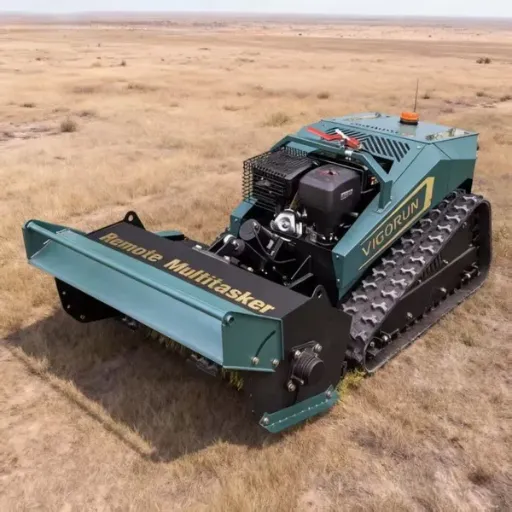
Daily, Weekly, and Seasonal Checklists
A gasoline engine asks for basic attention. It repays that attention with thousands of hours of service.
Daily checks (five minutes):
Engine oil level
Air filter condition
Fuel line leaks
Loose fasteners after vibration
Weekly checks (fifteen minutes):
Clean debris from cooling fins and recoil starter
Inspect spark plug color (tan is correct, black is rich, white is lean)
Check track or wheel hardware torque
Seasonal service (one hour):
Change oil and filter
Replace or clean air filter element
Inspect fuel filter and lines
Check blade or flail bolt torque
Grease all fittings
These intervals assume clean grass conditions. Dusty, sandy, or brush-cutting environments compress the schedule. A mower working in crushed-concrete debris needs the air filter checked daily.
Common Gas Engine Failures and How to Avoid Them
The three most common failures are preventable.
Dirty air filter. Dust and grass debris choke airflow. The engine runs rich, fouls the plug, and loses power. Clean or replace the filter every twenty-five hours in dirty conditions.
Old fuel. Varnish clogs the carburetor jet. The engine surges, stalls, or refuses to start. Use stabilizer. Drain for long storage. Buy fuel in quantities you will use within sixty days.
Low oil level. Air-cooled engines run hot. Oil breaks down faster than in a car. Check the dipstick every morning. Change the oil every fifty hours or annually, whichever comes first.
Viktor Novak runs a vegetation management fleet in Slovenia with fourteen gasoline remote mowers. He tracks every machine on a simple spreadsheet. Oil changes happen at forty-five hours, never later. Air filters are replaced, not cleaned, at one hundred hours. His oldest unit has 2,800 hours on the original engine. The secret is not premium parts. It is the discipline to follow the schedule.
How to Choose the Right Gasoline Remote Mower for Your Terrain
Start with the job, not the brochure.
Measure your typical slope angle. Above 30 degrees, you need track chassis and sufficient torque to climb while cutting. A 224cc engine will struggle. A 452cc engine will not.
Estimate your daily cutting area. Below one hectare, battery may still compete. Above three hectares, gasoline is the only practical choice.
Identify your vegetation type. Grass and light weeds need less power than blackberry thickets or saplings. Match the deck type—rotary, flail, or mulching—to the material.
Check emissions requirements for your market. Importing into Germany, France, or California demands certified engines. Verify certification before purchase.
Evaluate parts and service support. A gasoline engine is a proven technology. Any small-engine mechanic can service it. But you still need factory-direct access to gaskets, filters, and ignition components. Ask the supplier for their parts catalog and lead time before you sign.
Ready to compare engine options for your terrain? Request a detailed specification sheet and factory-direct quote for a gasoline remote control lawn mower matched to your application.
Conclusion
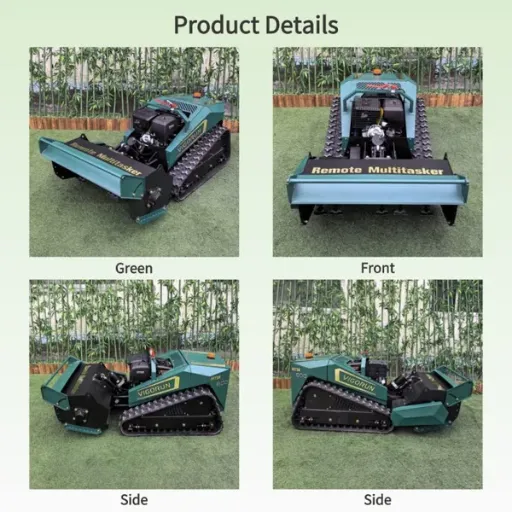
A gasoline remote control lawn mower is not an outdated choice. It is the correct choice for operators who cannot afford downtime, who work terrain that punishes underpowered machines, and who need all-day runtime without battery logistics.
The technology is mature. The engines are certifiable. The fuel infrastructure already exists on every job site. What separates a reliable machine from a headache is matching the engine to the work, verifying emissions compliance before import, and following a basic maintenance schedule.
Buyers who get this right follow the same steps. They measure their terrain and vegetation. They confirm certification for their market. They match displacement to deck size. They verify parts availability. Then they choose a manufacturer who builds the engine into the machine, not a trading company who bolts on whatever is cheapest this month.
If you are specifying equipment for slope maintenance, brush clearing, or commercial vegetation management, start with the workload. Then request a detailed engine specification and factory-direct quote for a gasoline remote control lawn mower built to handle it.
Recently Posted
-
Remote Control Agricultural Fog Cannon Sprayer Vehicle 600L Tank Smart Farming Dust Suppression Mach
August 12, 2026Dual 1500W Brushless Motors and Direct-Drive for High Torque Performance: Two all-copper brushless motors deliver powerful efficient output with smooth power transfer and enhanced durability for demanding sunflower field spraying.Remote Control Operation with 200m Range for Safe Chemical Application: Protect operators from chemical exposure and hazardous terrain with full remote control of pump and mist cannon, reducing wasteRead More -
Electric Remote Control Orchard Sprayer with Dual Battery Power and Efficient Airblast Spray Perform
August 12, 2026Vigorun Agricultural Sprayers for Tractor, 60V 20Ah Battery Gasoline Power Sprayer Pump Agricultural for Berry FarmsPowerful dual Read More
 -
MTSK800 40 Degree Slope 800mm Remote Control Tracked Multifunctional Worm Gear Weed Cutter
August 12, 202640 Degree Slope 800mm Remote Control Tracked Multifunctional Worm Gear Weed CutterEngineered for 40-Degree Slopes: crawler chassis Read More
 -
Multifunctional 800mm Remote Control Tracked 40 Degree Servo Motor Grass Trimmer
August 12, 2026Multifunctional 800mm Remote Control Tracked 40 Degree Servo Motor Grass TrimmerMultifunctional Quick-Swap Platform: front attachm Read More

Contact Us
Recommended Products
-
 Vigorun Lawn Mower Robot, Industrial Dual 48V 1500W Motors MTSK1000 Mulcher Machine for Large LandscapesUS$ 7500.00 - 7700.00MOQ: 1 Set
 -
Farmland Orchards Battery Powered Mower Gasoline Golf Mower Robot Lawn Mower 3000m2 Vigorun Remote Control Grass MowerUS$ 2580 - 2700MOQ: 1 Unit
-
Vigorun MTSK800 Automatic Remote Control Grass Cutting Machine 48V 20Ah Battery Remote Flail MowerUS$ 2800 - 2900MOQ: 1 Set
-
Vigorun MTSK1000 Remote Control Mower 24hp Fail-Safe Slope Braking Remote Control Forest MulcherUS$ 8000 - 8200MOQ: 1 Set
-
Industry Electric Motor Lawn Mower Flail Mower Atv Gasoline Hedge Trimmer Battery LawnmowerUS$ 2580 - 2900MOQ: 1 Unit
-
Vigorun Agricultural Tractor Sprayer Euro 5/EPA Electric Agricultural Sprayer 600l for VineyardsUS$ 2600 - 2700MOQ: 1 Set
-
Remote Control Tracked Hillside Mower 800mm Cutting Width 60 Degree Slope for Steep Terrain VegetationUS$ 2600 - 2700MOQ: 1 Set
-
Vigorun VTLM600 RC Lawn Mower Robot CE EPA Certified 45° Extreme Slope Mini Crawler Lawn MowerUS$ 1700 - 17900MOQ: 1 Set
-
Remote Controlled High Efficiency Fog Cannon Spraying Machine 600L Tank for Agriculture and Dust ControlUS$ 2800 - 2900MOQ: 1 Set
-
Vigorun Radio Control Mowing Euro 5/EPA Self-Propelled & Precise 6hp Remote Control Crawler MowerUS$ 1700 - 1790MOQ: 1 Set
-
Factory Manufacturer Vigorun MTSK1000 1000MM Commercial Branch Cutter Flail Mower rc Remote Petrol Lawnmower Mower Grass Cutter TractorUS$ 8000 - 8200MOQ: 1 Set
-
Vigorun VTW550 Remote Control Grass Cutter Tractor Robot Gas Lawn Mower Grass Cutter Small Electric Lawn Mower Vigorun Lawn MowerUS$ 1000 - 1250MOQ: 1 Set
-
Vigorun Tech Gasoline Remote Control Lawn Mower Self-Locking Slope Safety RC Mower Tiller for EmbankmentsUS$ 2800.00 - 2900.00MOQ: 1 Set
-
Mower Gasoline Grass Cutter Machine Remote Control 1000mm Cut 35 Degree Slope Flail Hammer for Overgrown LandUS$ 7500 - 7700MOQ: 1 Set
-
Vigorun VTLM800 Remote Control Electric Mower, Self-Locking Slope Safety Crawler Mower for Steep SlopesUS$ 2600.00 - 2700.00MOQ: 1 Set


-
Shrub and Brush Clearing MTSK800 MTSK1000 Flail Mower rc Remote Weeding Weeder MachineUS$ 2800 - 2900MOQ: 1 Set
-
RC Robot Lawn Mower Electric Remote Control Flail Grass Cutter Garden Cutting Machine MTSK1000US$ 8000 - 8200MOQ: 1 Set
-
Remote Manipulation Rubber Track Brush Cutter Industrial Flail Mower for Efficient Shrub ClearingUS$ 2000.00 - 2790.00MOQ: 1 Set
-
Vigorun MTSK1000 Rc Lawn Mower, Loncin 764CC Gasoline Engine Forestry Mulcher With Remote Control for ForestryUS$ 7500.00 - 7700.00MOQ: 1 Set
-
Vigorun VTC550 Zero Turn Electric Mower Quality Guaranteed Crawler Brush Cutter For Embankments & LeveesUS$ 1600 - 1690MOQ: 1 Set