
 Business License

Remote Control Lawn Mower for Steep Slopes: A Field Engineer's Guide
Carlos Mendez watched the retention pond embankment from the cab of his pickup. The grass was knee-high, the grade was 38°, and the soil was still damp from the weekend storm. His crew had walked that slope with string trimmers last month. One worker had slipped, bruised a hip, and called in sick for a week. Carlos needed a different answer. He needed a remote control lawn mower for steep slopes, not another hand crew.
That situation repeats every spring across municipal districts, solar farms, orchards, and estates. A slope too steep for a ride-on and too dangerous for a walk-behind becomes a maintenance backlog that grows into a fire risk, a compliance fine, or an injury report. The right machine changes the equation entirely.
This article explains what makes a remote control lawn mower suitable for steep slopes, why tracked chassis and low center of gravity matter more than engine size, and how to match a machine to your actual terrain. By the end, you will know how steep is too steep, what safety systems are non-negotiable, and which Vigorun model fits your job.
Browse the full Vigorun slope mower range to see the tracked models built for this class of work.
What Counts as a Steep Slope (and Why Most Mowers Fail)
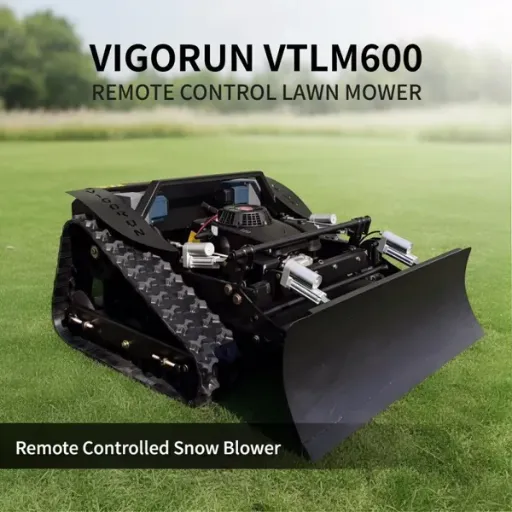
Slope is measured in degrees, not adjectives. A gentle residential lawn might sit at 5-10°. A challenging golf-course fairway could hit 15-20°. Commercial slope work starts at 25° and climbs from there.
15-25°: Most ride-on mowers reach their limit
25-35°: Zero-turn mowers lose traction; walk-behinds become exhausting
35-45°: Only specialized slope equipment operates safely
Above 45°: Specialized winch-assisted or tracked machines required
Most traditional mowers fail on steep terrain for three reasons. First, their center of gravity sits too high, creating rollover risk on side slopes. Second, wheels concentrate weight on small contact patches, causing slips on damp grass. Third, the operator rides the machine, which means any accident involves a human.
A remote control lawn mower for steep slopes solves all three problems. The operator stands off the terrain. The chassis sits low and wide. The tracks or specialized wheels spread load across a larger footprint.
Why a Remote Control Lawn Mower for Steep Slopes Works
The physics of slope mowing favor three design choices: tracks over wheels, a low center of gravity, and distance between operator and machine.
Tracked chassis and ground pressure
Rubber tracks distribute the machine's weight across a longer, wider contact area than pneumatic tires. On a 40° face, that footprint is the difference between holding line and sliding downslope. A tracked slope mower also grips better on wet clay, loose embankment material, and uneven turf because the lug pattern bites into the surface rather than riding on top of it.
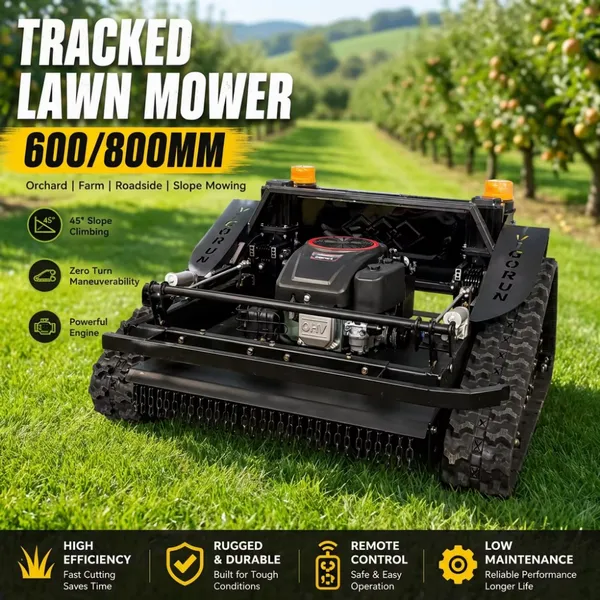
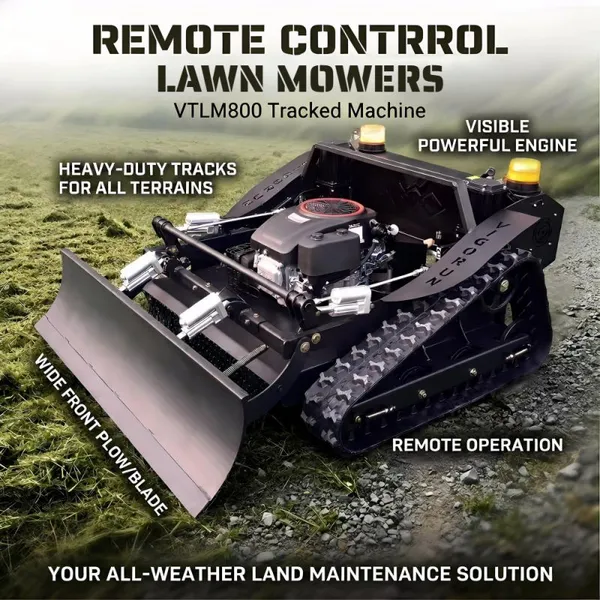
The Vigorun VTLM800 uses a rubber-track chassis specifically for this reason. Its 45° slope rating depends as much on track geometry as on engine torque.
Low center of gravity
Engineers use two strategies to keep a slope mower stable. They mount heavy components, the engine, fuel tank, hydraulic pump, and battery, as close to the ground as possible. They also widen the track stance relative to the machine's height. The result is a chassis that can traverse side slopes and climb faces without tipping.
The operator stays clear
Even the best-engineered machine can encounter surprises on steep ground: buried rocks, unexpected drop-offs, soft pockets. When the operator stands 200 meters away, those surprises do not involve a human injury. A remote control lawn mower for steep slopes is fundamentally a safety device, not just a cutting tool.
45° Slope Rating: What the Number Actually Means
Manufacturers often publish slope ratings without explaining the conditions behind them. A 45 degree slope mower rating assumes dry, firm grass or turf, a competent operator, and line-of-sight control. Change any of those variables, and the safe working slope drops.
| Condition | Effective Slope Capability | Why It Changes |
|---|---|---|
| Dry, firm grass | 45° | Maximum rated traction and stability |
| Wet grass | 35-40° | Reduced track-to-surface friction |
| Loose soil or gravel | 30-35° | Footprint sinks or slips |
| Side slope traverse | 35-40° | Lateral tipping force increases |
| Tall, heavy brush | 30-35° | Deck load and drag reduce stability |
Vigorun publishes a 45° rating for the VTLM800 because that is what the machine achieves on our own test ramps under controlled conditions. We also tell operators to stay under 35° on wet or loose terrain. The rating is a ceiling, not a recommendation for every condition.
Mini-story: The bid that depended on the rating
In March 2026, a municipal maintenance supervisor in Portugal named Ana Ribeiro needed to bid a highway embankment contract. The spec required mowing slopes up to 38°. Her department owned a ride-on rated to 20°. She evaluated three remote mowers and chose the VTLM800 specifically because its 45° rating gave her 7° of margin above the contract requirement. That margin covered wet spring grass and uneven fill soil. Her crew completed the contract without a single safety incident, and the department added a second VTLM800 to the fleet six months later.
Terrain That Changes the Math
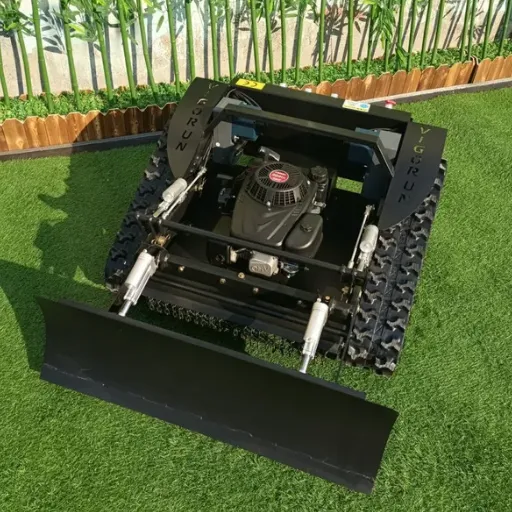
Not all steep slopes behave the same way. A dry orchard terrace in Spain is different from a wet levee in Louisiana or a rocky hillside in Chile. When you choose a remote control lawn mower for steep slopes, match the machine to the terrain, not just the angle.
Clay embankments and levees
Clay holds water. After rain, the surface layer becomes slick even when the slope looks manageable. Tracks with aggressive lug patterns outperform wheels here because they bite through the slick top layer. The VTLM800's rubber-track design was tested specifically for this kind of moist embankment work.
Rocky or uneven slopes
Hidden stones and ruts create sudden track impacts. A commercial-grade slope mower needs undercarriage protection, robust track rollers, and a blade clutch that can absorb strikes without damage. Operators should walk the slope before mowing, but the machine still needs physical protection for the unexpected.
Orchard and vineyard terraces
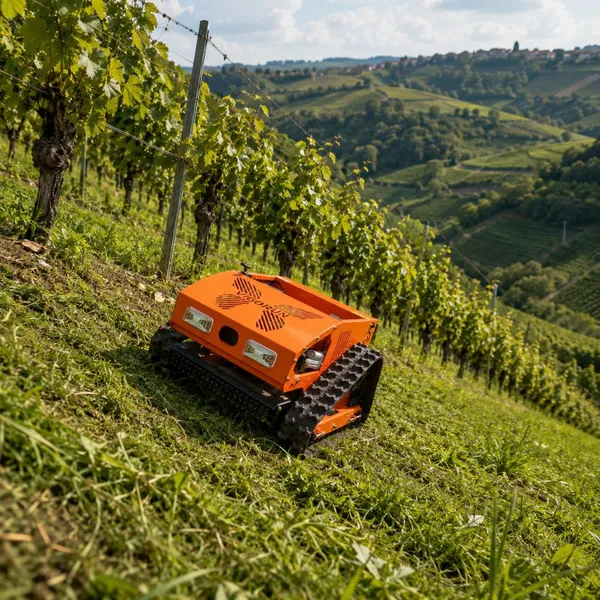
Terraced slopes often include steep transitions between levels and obstacles like tree trunks, trellis posts, and drainage channels. A compact tracked chassis with good ground clearance navigates these better than larger equipment. The operator can also position for maximum visibility, which matters more on irregular terrain than on straight embankments.
Solar farm rows
Solar farms typically sit on gentler slopes, but the safety logic is the same. Operators should not be near energized equipment with hand tools. A remote mower with 200-meter range lets one person clear vegetation between arrays from a safe, stable position.
Safety Systems Built for Steep Work
Steep-slope mowing is not a place to compromise on safety. A commercial remote control lawn mower for steep slopes should include four independent systems.
1. Lost-signal failsafe
If the transmitter and receiver lose connection for more than 0.5 to 1.5 seconds, the machine should drop to idle, stop the blades, and brake the tracks. On a 35° slope, a runaway machine is almost as dangerous as a runaway ride-on. The failsafe prevents that.
2. Emergency stop on transmitter and chassis
The operator carries a hardware E-stop button. Anyone near the machine can press a second E-stop on the chassis. Both commands cut engine power and disengage the blade clutch immediately.
3. Blade engagement lockout
Starting the blades should require a deliberate two-step command. This prevents accidental blade engagement during transport or positioning on a slope.
4. Anti-rollover geometry
A wide track stance, low-mounted fuel tank, and engine placement close to the frame floor all reduce the center-of-gravity height. The goal is simple: keep the machine stable during direction changes on steep faces and side slopes.
Safety note: Even with these systems, always position yourself uphill of the cutting path and maintain line of sight. The remote keeps you off the slope, but only if you stay in a stable location with full signal.
Choosing the Best Remote Control Mower for Steep Hills
The best remote control mower for steep hills depends on three factors: slope angle, terrain type, and vegetation density.
| Your Slope / Terrain | Recommended Approach | Vigorun Model |
|---|---|---|
| 35-45°, wet or uneven | Maximum traction, low CG | VTLM800 |
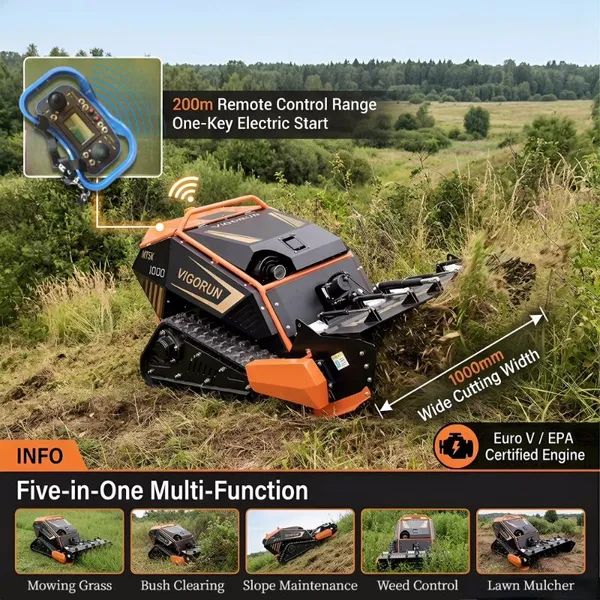
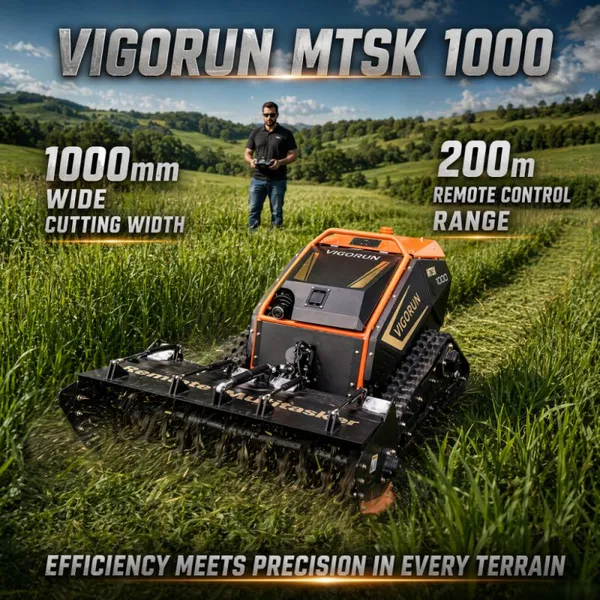
| 30-40°, mixed brush | Flail head + tracked chassis | MTSK1000 |
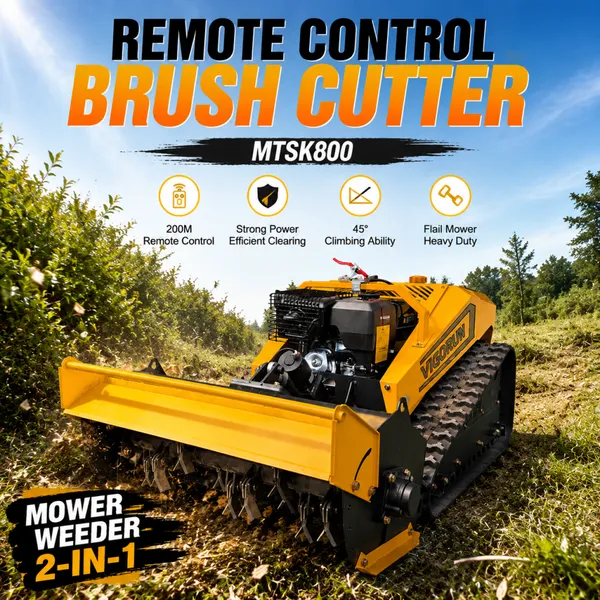
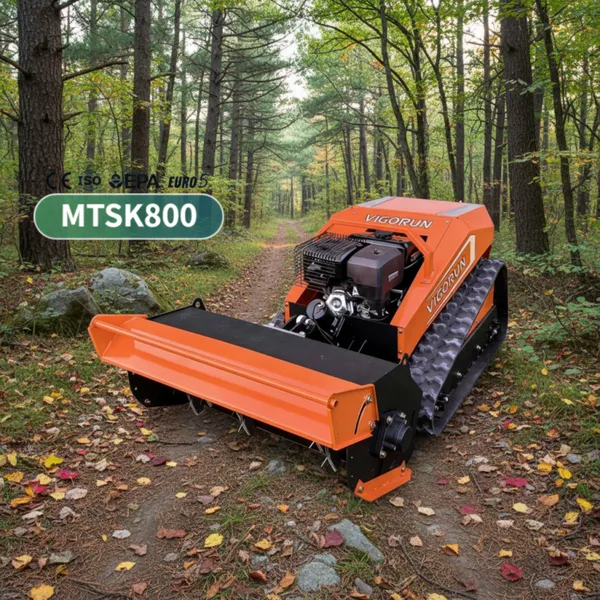
| 25-35°, orchards / vineyards | Compact maneuverability + flail | MTSK800 |
| 20-30°, solar farms / estates | Standard tracked mower | VTLM800 or MTSK800 |
The VTLM800 is purpose-built as a 45 degree slope mower. Its track width, chassis length, and sump-modified engine are all optimized for sustained steep work. The MTSK1000 adds a heavy-duty flail head for woody brush and saplings up to 25 mm thick, making it the better choice for overgrown embankments. The MTSK800 covers the middle ground: steep slopes plus multi-attachment versatility.
See the VTLM800 rubber track slope mower specifications if your job involves sustained slopes above 35°.
Operating Tips for Slopes Above 30°
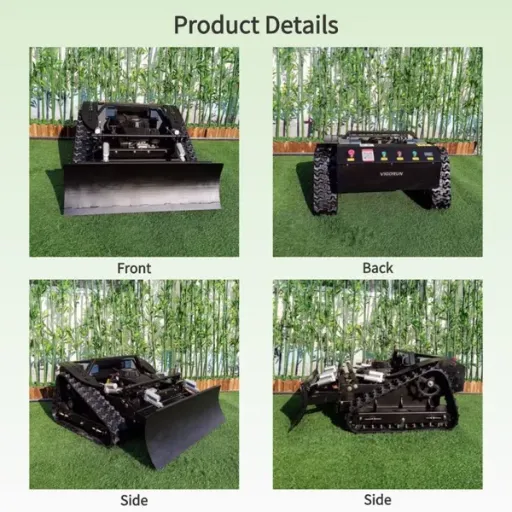
Owning the right machine is only half the task. Operating it correctly on steep ground is the other half.
Walk the slope first. Remove visible stones, wire, branches, and debris. Identify soft spots, drop-offs, and drainage channels.
Position uphill. Stand above the cutting path with clear line of sight. Never stand below the machine on a steep face.
Test controls on flat ground. Verify forward, reverse, left, right, blade engagement, and E-stop before reaching the slope.
Mow across the slope when possible. Side-hill passes reduce the risk of end-over-end rollover compared to straight up-and-down passes on very steep faces.
Reduce speed. Ground speed on a 40° slope should be noticeably slower than on flat ground. Precision matters more than speed.
Watch the discharge direction. Clippings and debris will travel downslope. Position yourself and any bystanders accordingly.
Stop in bad weather. Heavy rain, standing water, and electrical storms increase slip risk and reduce traction.
Mini-story: The wrong angle on a vineyard terrace
Henrik Bergman, a vineyard manager in northern Germany, bought a remote mower for his terraced hillside in 2025. The machine was rated to 40°, and his terraces averaged 32°. On paper, the match was perfect. But Henrik's first operator tried to mow straight up and down the steepest face instead of across the slope. The machine held traction, but the cut quality was uneven and the operator felt the chassis shift more than necessary. After a brief training session, the crew switched to side-hill passes at reduced speed. Fuel consumption dropped, cut quality improved, and the operator gained confidence. "The machine was capable," Henrik said. "The operator just needed to let it work the way it was designed."
Maintenance on Slope Mowers
Steep work accelerates wear on the components that matter most. A slope mower maintenance plan should prioritize these items.
Daily checks
Track tension and lug condition
Engine oil level
Hydraulic fluid level
Blade condition and tightness
Transmitter battery charge
Receiver antenna connection
Weekly or hourly checks
Air filter (dusty embankments clog filters faster)
Hydraulic filter
Grease points on track rollers and blade spindles
Undercarriage for packed mud or debris
Seasonal service
Engine oil and filter change
Hydraulic oil and filter change
Track replacement if lugs are worn smooth
Spark plug inspection
Controller firmware update if available
Slope work eats tracks, blades, and undercarriage components faster than flat-ground mowing. Vigorun ships every unit with an English-language manual, parts diagram, and whole-life parts support. Keeping a spare set of wear parts on hand is standard practice for commercial slope operators.
Common Questions About Remote Control Slope Mowers
How steep can a remote mower climb?
A tracked commercial unit like the VTLM800 is rated to 45° on dry, firm grass. Wet or loose terrain reduces effective capability to roughly 35°. Always follow the manufacturer's guidance for your specific model.
Are remote mowers safer than ride-ons on hills?
Yes, because the operator is not on the machine. The 200-meter remote distance eliminates rollover injuries, projectile-debris strikes, and heat exhaustion on steep faces.
What tracks are best for wet slopes?
Rubber tracks with aggressive lug patterns outperform pneumatic tires on wet clay and turf. The longer and wider the track footprint, the better the grip on soft or uneven terrain.
Can a remote mower handle rocky slopes?
Commercial units with undercarriage protection and robust track rollers can handle moderate rock and debris. Operators should still walk the slope and remove large obstacles before mowing.
What is the best remote control mower for steep hills?
For sustained slopes above 35°, the Vigorun VTLM800 is purpose-built with a 45° slope rating. For overgrown brush on 30-40° terrain, the Vigorun MTSK1000 remote control flail mower is the better fit.
Conclusion: Match the Machine to the Slope
A remote control lawn mower for steep slopes is not a luxury. For slopes above 30°, it is the safest practical way to maintain grass, brush, and vegetation without putting an operator at risk. The combination of tracked chassis, low center of gravity, 200-meter remote range, and layered safety systems makes sustained steep mowing possible.
The key is matching the machine to the actual terrain. A 45 degree slope mower like the VTLM800 handles the steepest sustained embankments. A flail-equipped MTSK1000 clears heavy brush on moderate-to-steep terrain. Both keep the operator off the slope and both arrive after 100% indoor and outdoor factory testing.
At Vigorun, we build every slope mower in our Weifang facility, test every unit indoors and outdoors before shipment, and back every machine with a 1-year warranty plus whole-life parts support. If you are evaluating a remote control lawn mower for steep slopes on your property or for your fleet, the next step is straightforward.
Contact the Vigorun sales team to request a spec sheet, book a virtual factory tour, or ask which model matches your specific slope angle and terrain.
Recently Posted
-
Steep Slope 600mm Tracked 200m Remote Control 45 Degree Brushless Electric Lawn Mower
August 10, 2026*Integrated Drive System with 73 Percent Efficiency: The VTLM600 remote control lawn mower features a fully integrated brushless m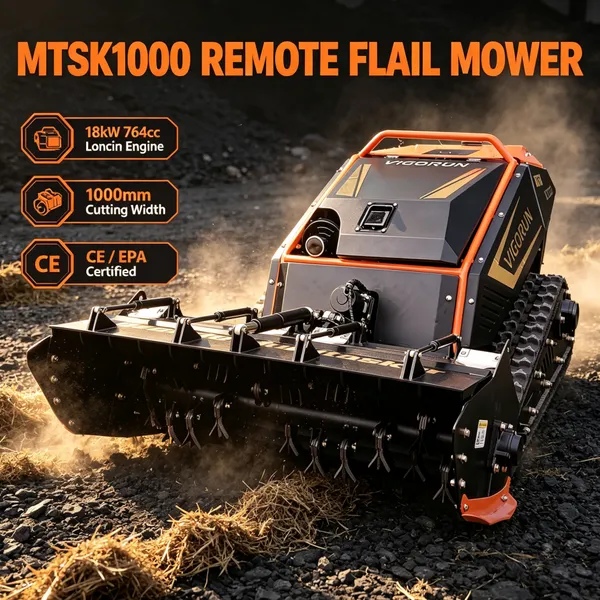 Read More
 -
Remote Controlled Pesticide Sprayer with 600L Tank 8.4m Boom for Agricultural Applications
August 10, 2026*Electric Start & 13kW Loncin Engine for Powerful Agricultural Spraying: Maximize field application efficiency with the SPRY60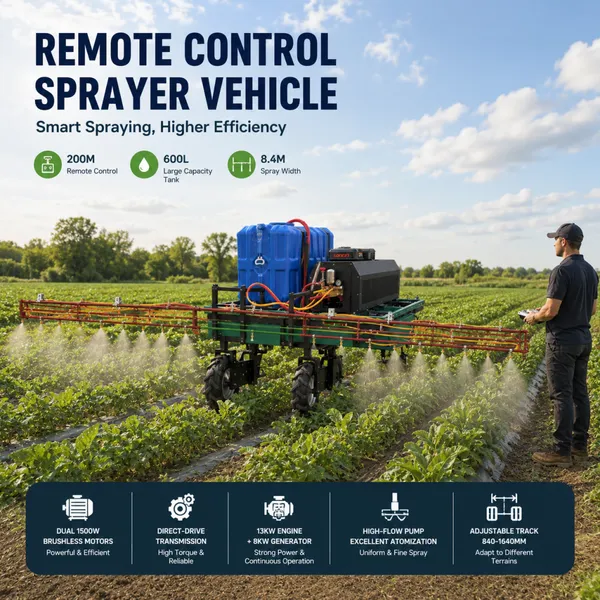 Read More
 -
Self Propelled Agricultural Boom Sprayer with Adjustable Track for Modern Farming
August 10, 2026*Electric Start & 13kW Loncin Engine for Powerful Agricultural Spraying: Maximize field application efficiency with the SPRY60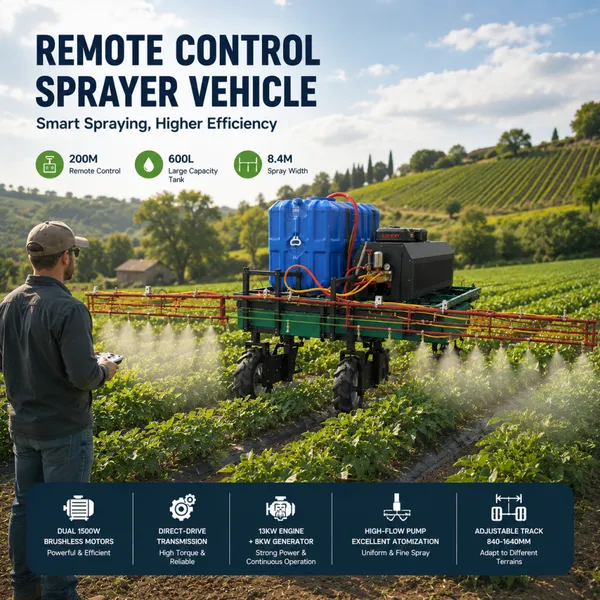 Read More
 -
Automatic Remote Control Agricultural Spray Machine with 600L Chemical Tank and Boom System
August 10, 2026*Electric Start & 13kW Loncin Engine for Powerful Agricultural Spraying: Maximize field application efficiency with the SPRY60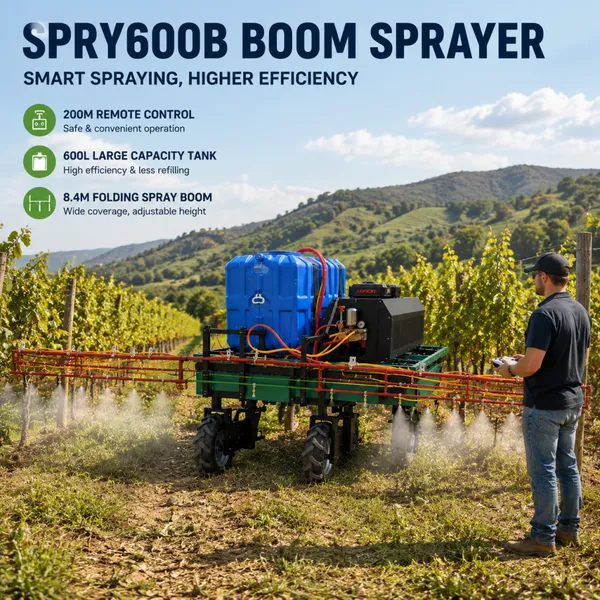 Read More

Contact Us
Recommended Products
-
 Vigorun Lawn Mower Robot, Industrial Dual 48V 1500W Motors MTSK1000 Mulcher Machine for Large LandscapesUS$ 7500.00 - 7700.00MOQ: 1 Set
 -
Farmland Orchards Battery Powered Mower Gasoline Golf Mower Robot Lawn Mower 3000m2 Vigorun Remote Control Grass MowerUS$ 2580 - 2700MOQ: 1 Unit
-
Vigorun MTSK800 Automatic Remote Control Grass Cutting Machine 48V 20Ah Battery Remote Flail MowerUS$ 2800 - 2900MOQ: 1 Set
-
Vigorun MTSK1000 Remote Control Mower 24hp Fail-Safe Slope Braking Remote Control Forest MulcherUS$ 8000 - 8200MOQ: 1 Set
-
Industry Electric Motor Lawn Mower Flail Mower Atv Gasoline Hedge Trimmer Battery LawnmowerUS$ 2580 - 2900MOQ: 1 Unit
-
Vigorun Agricultural Tractor Sprayer Euro 5/EPA Electric Agricultural Sprayer 600l for VineyardsUS$ 2600 - 2700MOQ: 1 Set
-
Remote Control Tracked Hillside Mower 800mm Cutting Width 60 Degree Slope for Steep Terrain VegetationUS$ 2600 - 2700MOQ: 1 Set
-
Vigorun VTLM600 RC Lawn Mower Robot CE EPA Certified 45° Extreme Slope Mini Crawler Lawn MowerUS$ 1700 - 17900MOQ: 1 Set
-
Remote Controlled High Efficiency Fog Cannon Spraying Machine 600L Tank for Agriculture and Dust ControlUS$ 2800 - 2900MOQ: 1 Set
-
Vigorun Radio Control Mowing Euro 5/EPA Self-Propelled & Precise 6hp Remote Control Crawler MowerUS$ 1700 - 1790MOQ: 1 Set
-
Factory Manufacturer Vigorun MTSK1000 1000MM Commercial Branch Cutter Flail Mower rc Remote Petrol Lawnmower Mower Grass Cutter TractorUS$ 8000 - 8200MOQ: 1 Set
-
Vigorun VTW550 Remote Control Grass Cutter Tractor Robot Gas Lawn Mower Grass Cutter Small Electric Lawn Mower Vigorun Lawn MowerUS$ 1000 - 1250MOQ: 1 Set
-
Vigorun Tech Gasoline Remote Control Lawn Mower Self-Locking Slope Safety RC Mower Tiller for EmbankmentsUS$ 2800.00 - 2900.00MOQ: 1 Set
-
Mower Gasoline Grass Cutter Machine Remote Control 1000mm Cut 35 Degree Slope Flail Hammer for Overgrown LandUS$ 7500 - 7700MOQ: 1 Set
-
Vigorun VTLM800 Remote Control Electric Mower, Self-Locking Slope Safety Crawler Mower for Steep SlopesUS$ 2600.00 - 2700.00MOQ: 1 Set
-
Shrub and Brush Clearing MTSK800 MTSK1000 Flail Mower rc Remote Weeding Weeder MachineUS$ 2800 - 2900MOQ: 1 Set
-
RC Robot Lawn Mower Electric Remote Control Flail Grass Cutter Garden Cutting Machine MTSK1000US$ 8000 - 8200MOQ: 1 Set
-
Remote Manipulation Rubber Track Brush Cutter Industrial Flail Mower for Efficient Shrub ClearingUS$ 2000.00 - 2790.00MOQ: 1 Set
-
Vigorun MTSK1000 Rc Lawn Mower, Loncin 764CC Gasoline Engine Forestry Mulcher With Remote Control for ForestryUS$ 7500.00 - 7700.00MOQ: 1 Set
-
Vigorun VTC550 Zero Turn Electric Mower Quality Guaranteed Crawler Brush Cutter For Embankments & LeveesUS$ 1600 - 1690MOQ: 1 Set