
 Business License

Best Brush Cutter for Heavy Vegetation and Slope Work
Diego's crew had cleared the same 30-degree riverbank three times in one season. Each pass with a standard rotary mower left woody stems standing, and within six weeks the brush grew back thicker than before. On the fourth visit, a hand-held string trimmer kicked a rock into a worker's shin. That was the day Diego stopped looking for a "better" mower and started looking for the best brush cutter his budget could justify.
If you're maintaining slopes, riverbanks, orchards, or overgrown estates, you already know the difference between a lawn mower and a real brush cutter. The best brush cutter for commercial work isn't defined by horsepower alone. It's the combination of cutting-head design, chassis stability, slope rating, and the ability to handle woody growth without bogging down or snapping spindles.
In this guide, we'll break down what separates a true commercial brush cutter from a rebranded lawn mower, how to match the machine to your vegetation type, and why a growing number of slope-maintenance contractors are moving to remote-controlled brush cutters for safety and productivity. Every spec we reference is drawn from Vigorun's own engineering data and 15 years of shop-floor experience building tracked mowers in Weifang, Shandong.
Ready to see which cutting head fits your terrain? Browse the full Vigorun remote control lawn mower range and compare flail and rotary configurations side by side.
What "Best Brush Cutter" Actually Means on a Job Site
The phrase "best brush cutter" shows up in search results attached to everything from 200handheldstrimmersto200handheldstrimmersto50,000 hydro-ax machines. For commercial operators and the distributors who supply them, the category breaks into three practical tiers:
Hand-held and walk-behind brush cutters, Suitable for light brush, fence lines, and small clearings. The operator carries the load, and slope work is limited to flat or gently rolling ground.
Ride-on brush cutters and slope mowers, Larger rotary decks or flail heads mounted on seated chassis. Effective on flat-to-moderate terrain, but rollover risk becomes critical above 15 degrees.
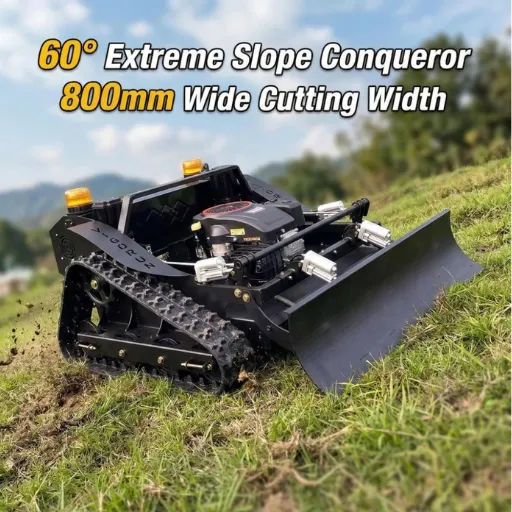
Remote-controlled brush cutters, Tracked or wheeled chassis operated by wireless remote, keeping the operator off the slope entirely. The only practical choice for sustained work above 25 degrees or in hazardous terrain.
The "best" machine for your application depends on slope angle, vegetation density, and how much risk you're willing to put on an operator. For municipal levees, highway embankments, solar farms, and orchard terraces, the remote-controlled category is increasingly the default, not because it's more expensive, but because it replaces labor cost and injury liability with a single capital purchase.
Distributor note: If you're building a catalog for commercial landscaping or municipal clients, the remote control brush cutter is the category with the fastest margin growth. Learn about OEM customization for your branded mower line.
Rotary Deck vs. Flail Head: The Choice That Determines Your Results
Most buyers shop for a brush cutter by engine size. That is a mistake. The cutting head determines what the machine can actually destroy and how cleanly it leaves the surface.
Rotary Mower Deck
A rotary deck spins one to three blades horizontally at high speed. It's the same principle as a standard lawn mower, but the blades are heavier, thicker, and often flail-style or saw-toothed for brush work.
Best for: Grass, weeds, and light brush up to 12 mm (0.5 in) diameter
Cutting quality: Clean finish on flat ground; scalps and skips on uneven terrain
Safety on slopes: High blade inertia can throw rocks and debris long distances
Maintenance: Blades are cheap and easy to swap; spindles take the abuse
Flail Mower Head
A flail head uses dozens of small, pivoting blades (flails) mounted on a horizontal drum. Each flail swings freely, retracting when it hits something solid, then extending again.
Best for: Woody brush, saplings, and dense overgrowth up to 25 mm (1 in) or more
Cutting quality: Mulches material finely; leaves a level finish even on uneven ground
Safety on slopes: Debris stays low because flails don't build the same centrifugal energy as rotary blades
Maintenance: Individual flails are inexpensive; the drum and bearings require periodic inspection
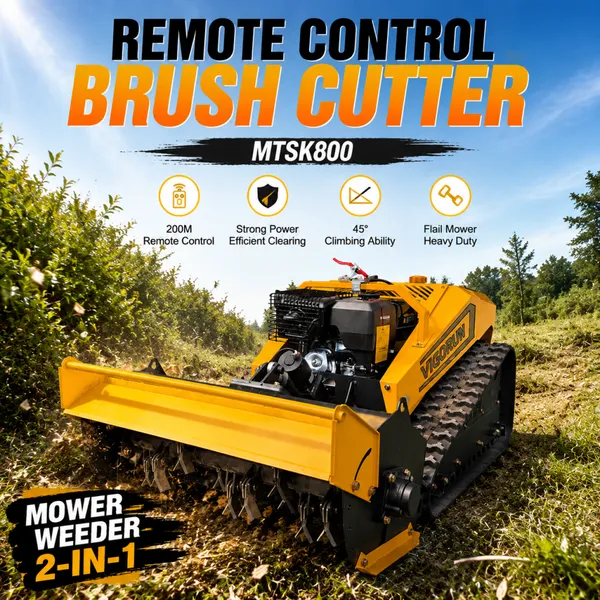
For commercial slope work, the flail head is almost always the better choice. It handles thicker growth, mulches instead of chopping, and poses less projectile risk to the operator or nearby property. That's why Vigorun's MTSK1000 remote control flail mower and MTSK800 remote controlled flail mower both ship with flail heads as standard, with rotary deck options available for grass-only contracts.
The Five Specs That Separate the Best Brush Cutters from the Rest
When you're evaluating a commercial brush cutter, whether for your own fleet or for resale, these five numbers matter more than brand name or paint color.
1. Engine Power and Emission Certification
Commercial brush cutters need sustained horsepower, not peak marketing numbers. A 22-hp gasoline engine with a governed PTO speed handles continuous brush load without overheating. More importantly, the engine must carry the right certifications for your market.
CE marking for European Union sales
EURO V emission compliance for EU member states
EPA certification for United States import and resale
CARB executive order if you're selling into California or CARB-aligned states
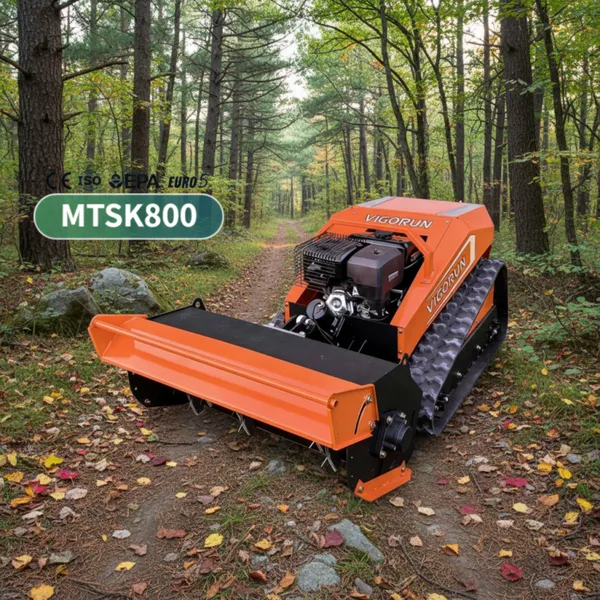
Vigorun gasoline engines ship with CE, EURO V, and EPA documentation as standard. Your customs broker gets the complete packet on day one.
2. Slope Rating and Chassis Geometry
A brush cutter that can't hold the slope is just an expensive lawn ornament. Look for:
Sustained slope rating, not peak marketing numbers. Any machine can climb a steep ramp for 30 seconds; the question is whether it can mow that slope for a full shift.
Track width and length. Wider, longer tracks distribute weight and grip better on wet grass and loose soil.
Center of gravity. Lower is better. A high-deck brush cutter on a tall chassis will tip sideways before it stalls.
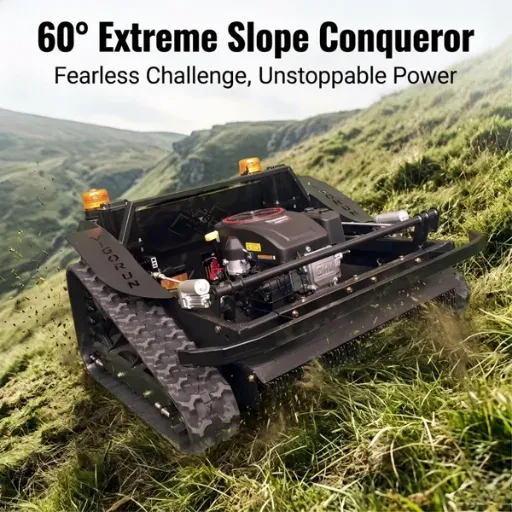
The Vigorun MTSK800 and MTSK1000 are rated for 40-degree sustained slopes on dry, firm ground. The VTLM800 slope mower pushes that to 45 degrees with a purpose-built low-CG chassis.
3. Cutting Width and Height Adjustment
Match the cutting width to your job type:
600-800 mm: Orchards, vineyards, and tight-row work where maneuverability matters
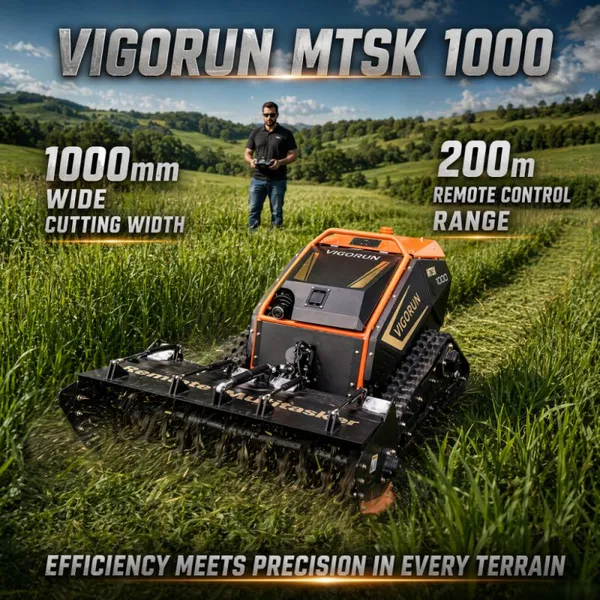
800-1,000 mm: General commercial maintenance, levees, and solar farms
1,000 mm+: Open-field vegetation management and highway right-of-way
Adjustable cutting height lets the same machine handle spring grass (lower) and summer brush (higher) without swapping heads.
4. Remote Control Range and Failsafes
For remote-controlled brush cutters, range and safety systems are as important as engine power.
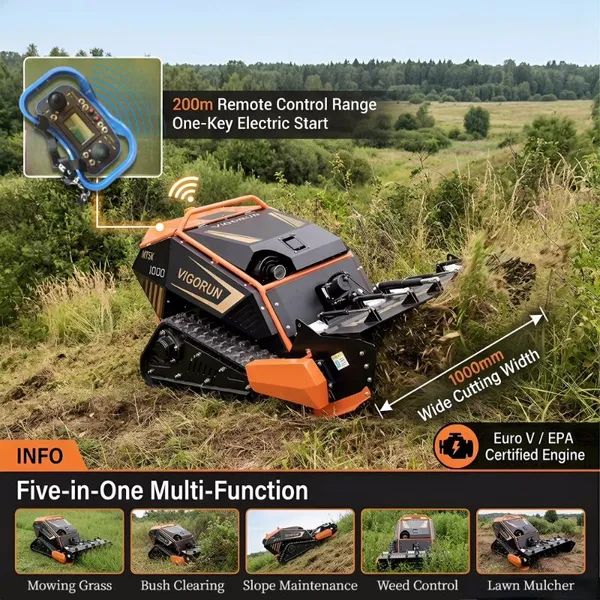
200-meter wireless range covers most job sites without repositioning the operator
Lost-signal failsafe stops blade and motion automatically if the radio link drops
Hardware emergency stop on both transmitter and chassis
Line-of-sight operation, no brush cutter should be operated around blind corners without spotters
5. Total Cost of Ownership (TCO)
Purchase price is only the first line item. Over five years, TCO includes:
Fuel and routine maintenance (oil, filters, belts, flails)
Parts replacement (tracks, blades, bearings, clutches)
Labor cost per acre cleared
Insurance and workers compensation exposure
Depreciation and resale value
A remote-controlled brush cutter typically replaces two operators on steep-slope work. At average landscaping labor rates, that payback period lands between 12 and 18 months for most commercial contractors.
Best Brush Cutter for Steep Slopes, Levees, and Riverbanks
Steep terrain is where handheld and ride-on machines fail, either because the operator can't stand on the slope or because the machine risks rollover above 15 degrees. For sustained slope work, the best brush cutter is a tracked, remote-controlled flail mower.
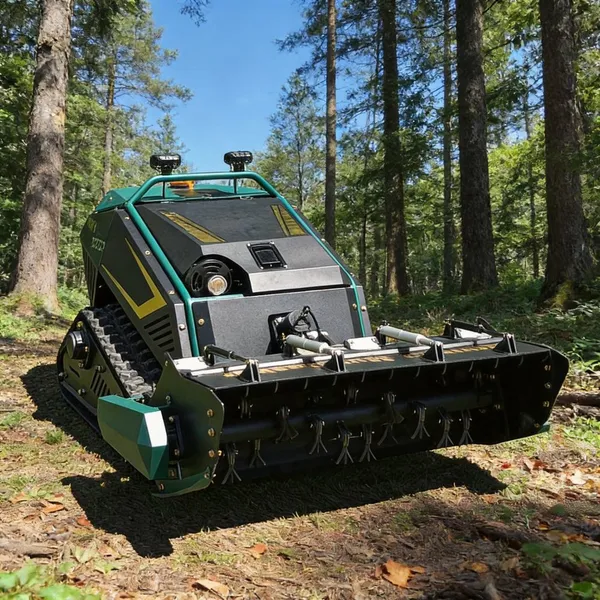
The Vigorun MTSK1000 was built for this exact application. Its rubber-track chassis distributes weight across a 200 mm by 1,200 mm footprint, the flail head mulches woody brush and saplings up to 25 mm thick, and the 22-hp EURO V / EPA-certified engine sustains full load on a 40-degree face. The operator stands 200 meters away on flat, safe ground, no roll-over risk, no flying debris, no heat exhaustion.
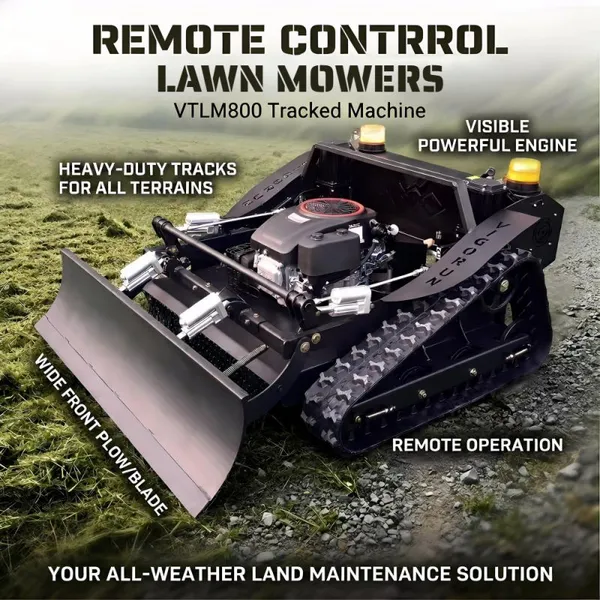
For even steeper terrain, the VTLM800 pushes the slope rating to 45 degrees with a purpose-built low-center-of-gravity chassis and sump-modified engine that maintains oil pressure at angle. It's the machine we recommend for levee districts, flood-control authorities, and any crew working consistently above 35 degrees.
Best Brush Cutter for Orchards, Vineyards, and Row Crops
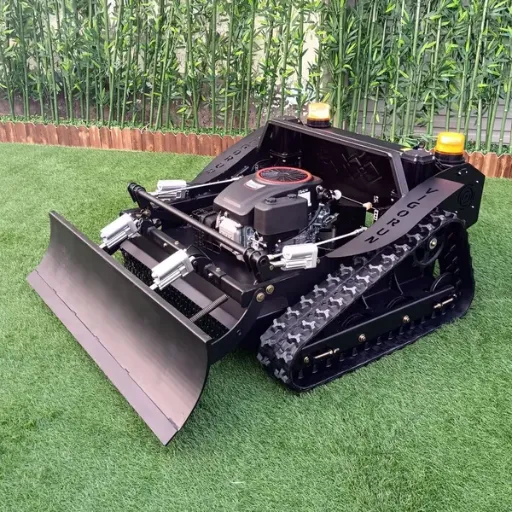
Orchard and vineyard maintenance presents a different challenge: the machine must fit between tree or vine rows without damaging trunks, while still clearing dense weed and groundcover growth.
The MTSK800 is the standard recommendation for row-crop work. Its 800 mm cutting width fits most orchard spacings, and the flail head mulches woody stems that would jam a rotary deck. The tracked chassis won't rut soft ground between rows the way wheeled machines do, and the 200-meter remote lets the operator stand clear of spray drift if the same chassis is fitted with a sprayer attachment later in the season.
Pro tip for distributors: The MultiTasker platform lets the same chassis swap between flail head, rotary deck, sprayer, and transport bed. One machine replaces three pieces of equipment in the customer's shed, and three lines in your catalog.
When Marcus, a vineyard manager in Chile's Colchagua Valley, switched from a three-person hand crew to a single remote-controlled flail mower, he cut his terrace maintenance time from four days per block to one. The flail head mulched the pruned canes and weed growth in a single pass, and the mulch layer reduced summer irrigation evaporation by roughly 15 percent. Marcus paid for the machine in 14 months through labor savings alone.
How to Match the Cutting Head to Your Vegetation Type
Choosing the wrong head for the vegetation is the most common mistake we see in the field. Here's the matching guide our dealers use:
| Vegetation Type | Recommended Head | Why |
|---|---|---|
| Grass and light weeds | Rotary deck | Fast, clean finish; low fuel consumption |
| Mixed grass and woody brush | Flail head | Mulches everything; handles uneven ground |
| Dense brush and saplings up to 25 mm | Heavy-duty flail head | Destroys woody growth without blade damage |
| Overgrown fields and right-of-way | Hammer mulcher or flail head | High-impact flails or hammers for thick stems |
| Orchards and vineyards between rows | Flail head (narrow width) | Mulches without throwing debris into tree canopy |
If your job site has mixed vegetation, grass in spring, brush in summer, spec a flail head with adjustable cutting height rather than swapping heads seasonally. The flail handles both conditions acceptably; the rotary deck handles only grass well.
Operating Costs: What the Best Brush Cutter Costs Over Five Years
Let's compare real five-year numbers for a commercial contractor clearing highway embankments and retention ponds. We'll use a remote-controlled flail mower against a two-person hand crew with handheld brush cutters.
Remote-controlled flail mower (MTSK1000 class):
Purchase + freight + import duty: ~28,000−28,000−32,000
Annual fuel and maintenance: ~$1,400
Annual parts (flails, belts, tracks): ~$2,000
Labor: One operator at $25/hour
5-year TCO: ~38,000−38,000−42,000
Two-person hand crew with handheld equipment:
Equipment purchase (2x commercial handheld, PPE, trailers): ~$4,000
Annual fuel and maintenance: ~$800
Annual parts and replacement equipment: ~$1,200
Labor: Two workers at $22/hour each, 800 hours/year
Workers compensation and insurance exposure: ~$3,500/year
5-year TCO: ~$226,000
The math is stark. Even at a conservative estimate, the remote-controlled machine pays for itself in the first 12 to 18 months. After that, every hour of slope work is pure labor-cost savings, plus the safety benefit of keeping humans off the embankment entirely.
For a distributor selling into municipal or commercial accounts, these TCO numbers are your strongest sales tool. We provide a TCO calculator spreadsheet to committed dealer partners.
What to Look for in a Brush Cutter Manufacturer
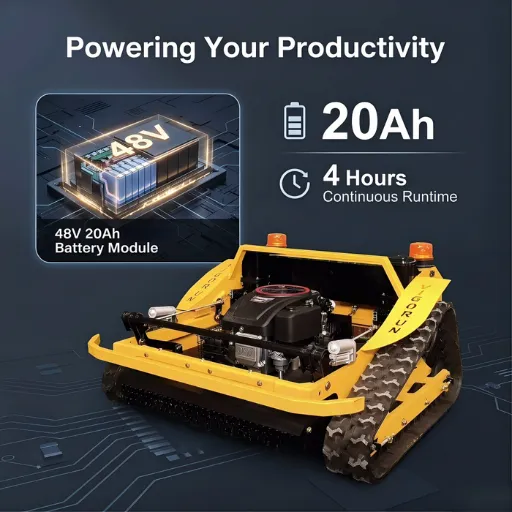
The best brush cutter is only as good as the factory that supports it. Before you buy, or before you add a unit to your dealer catalog, verify these five things about the manufacturer:
Are they the actual manufacturer? Ask for a live video factory tour. A real factory will show you welding stations, engine bays, and test ramps. A trading company will show you a warehouse.
Do they hold patents? Real engineering investment produces intellectual property. Vigorun's MTSK800 entered patent application in April 2026.
Are certifications current and model-specific? CE, EURO V, and EPA documents should reference the exact model number you're buying, not a generic factory certificate.
Is every unit tested before shipment? 100% indoor and outdoor field testing is the only way to guarantee the machine runs on arrival. Spot-checking is not enough.
What is the parts and warranty policy? A 1-year warranty is standard. Lifetime parts support is what separates a manufacturer from a reseller who will disappear in 18 months.
Vigorun builds every MTSK800, MTSK1000, and VTLM800 in our Weifang facility and tests each unit on our own slope ramps before crating. We ship approximately 200 mowers per month to dealers in 140+ countries, and we stock parts for the operational life of every machine we sell.
Conclusion: The Best Brush Cutter Keeps Your Operator Safe
The best brush cutter for your job isn't necessarily the one with the biggest engine or the widest deck. It's the machine that clears your vegetation type, holds your slope angle, and keeps your operator out of the danger zone, day after day, season after season.
Here are the five takeaways:
Match the head to the vegetation. Flail for brush and saplings; rotary for grass only.
Verify sustained slope ratings, not peak marketing claims. A 40-degree sustained rating beats a 55-degree peak stunt.
Demand current certifications. CE, EURO V, and EPA paperwork should match the exact model and engine in your quote.
Calculate five-year TCO, not just purchase price. Labor savings on slope work dwarf the machine cost.
Choose a manufacturer with real factory support. Lifetime parts and a 1-year warranty are non-negotiable for commercial work.
If you're still sending crews onto steep embankments with handheld trimmers or ride-on mowers that weren't designed for the angle, the math has already turned against you. A remote-controlled brush cutter replaces labor cost, reduces injury exposure, and opens bidding opportunities on terrain you previously couldn't touch.
Request a quote on the MTSK1000 or MTSK800, FOB Shandong pricing, full CE / EURO V / EPA documentation, and a container loading diagram within 24 hours. Ask about OEM customization if you're building your own brand.
Recently Posted
-
Steep Slope 600mm Tracked 200m Remote Control 45 Degree Brushless Electric Lawn Mower
August 10, 2026*Integrated Drive System with 73 Percent Efficiency: The VTLM600 remote control lawn mower features a fully integrated brushless m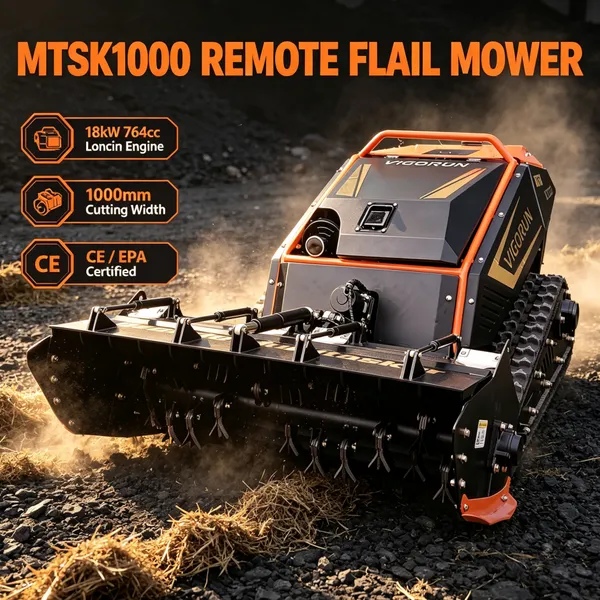 Read More
 -
Remote Controlled Pesticide Sprayer with 600L Tank 8.4m Boom for Agricultural Applications
August 10, 2026*Electric Start & 13kW Loncin Engine for Powerful Agricultural Spraying: Maximize field application efficiency with the SPRY60 Read More
 -
Self Propelled Agricultural Boom Sprayer with Adjustable Track for Modern Farming
August 10, 2026*Electric Start & 13kW Loncin Engine for Powerful Agricultural Spraying: Maximize field application efficiency with the SPRY60 Read More
 -
Automatic Remote Control Agricultural Spray Machine with 600L Chemical Tank and Boom System
August 10, 2026*Electric Start & 13kW Loncin Engine for Powerful Agricultural Spraying: Maximize field application efficiency with the SPRY60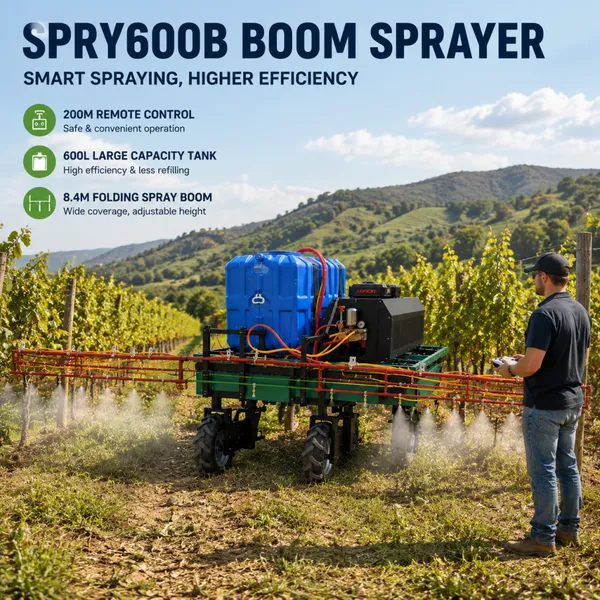 Read More

Contact Us
Recommended Products
-
 Vigorun Lawn Mower Robot, Industrial Dual 48V 1500W Motors MTSK1000 Mulcher Machine for Large LandscapesUS$ 7500.00 - 7700.00MOQ: 1 Set
 -
Farmland Orchards Battery Powered Mower Gasoline Golf Mower Robot Lawn Mower 3000m2 Vigorun Remote Control Grass MowerUS$ 2580 - 2700MOQ: 1 Unit
-
Vigorun MTSK800 Automatic Remote Control Grass Cutting Machine 48V 20Ah Battery Remote Flail MowerUS$ 2800 - 2900MOQ: 1 Set
-
Vigorun MTSK1000 Remote Control Mower 24hp Fail-Safe Slope Braking Remote Control Forest MulcherUS$ 8000 - 8200MOQ: 1 Set
-
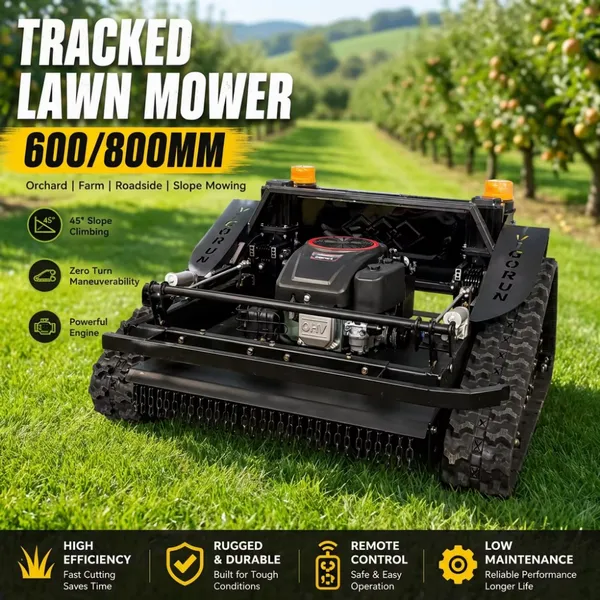
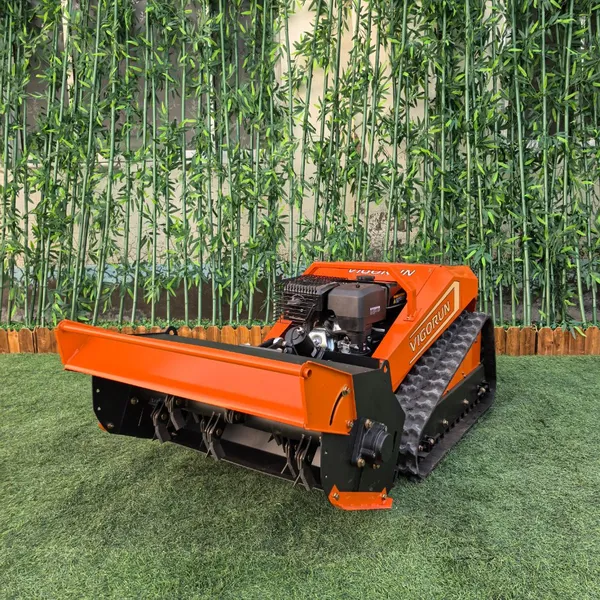
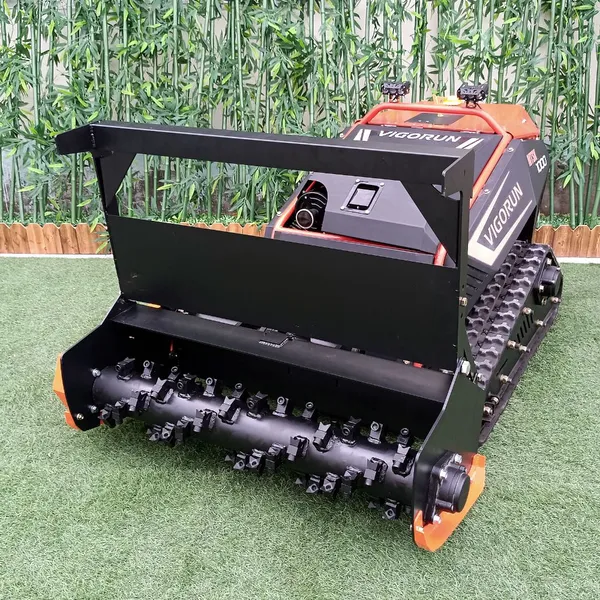
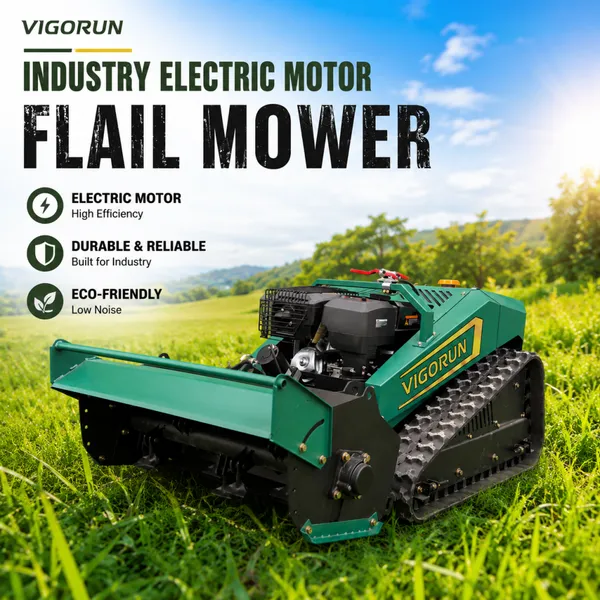
Industry Electric Motor Lawn Mower Flail Mower Atv Gasoline Hedge Trimmer Battery LawnmowerUS$ 2580 - 2900MOQ: 1 Unit
-
Vigorun Agricultural Tractor Sprayer Euro 5/EPA Electric Agricultural Sprayer 600l for VineyardsUS$ 2600 - 2700MOQ: 1 Set
-
Remote Control Tracked Hillside Mower 800mm Cutting Width 60 Degree Slope for Steep Terrain VegetationUS$ 2600 - 2700MOQ: 1 Set
-
Vigorun VTLM600 RC Lawn Mower Robot CE EPA Certified 45° Extreme Slope Mini Crawler Lawn MowerUS$ 1700 - 17900MOQ: 1 Set
-
Remote Controlled High Efficiency Fog Cannon Spraying Machine 600L Tank for Agriculture and Dust ControlUS$ 2800 - 2900MOQ: 1 Set
-
Vigorun Radio Control Mowing Euro 5/EPA Self-Propelled & Precise 6hp Remote Control Crawler MowerUS$ 1700 - 1790MOQ: 1 Set
-
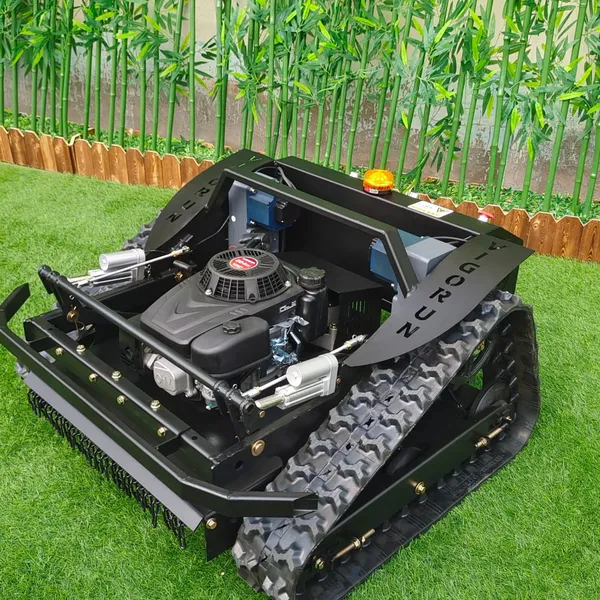
Factory Manufacturer Vigorun MTSK1000 1000MM Commercial Branch Cutter Flail Mower rc Remote Petrol Lawnmower Mower Grass Cutter TractorUS$ 8000 - 8200MOQ: 1 Set
-
Vigorun VTW550 Remote Control Grass Cutter Tractor Robot Gas Lawn Mower Grass Cutter Small Electric Lawn Mower Vigorun Lawn MowerUS$ 1000 - 1250MOQ: 1 Set
-
Vigorun Tech Gasoline Remote Control Lawn Mower Self-Locking Slope Safety RC Mower Tiller for EmbankmentsUS$ 2800.00 - 2900.00MOQ: 1 Set
-
Mower Gasoline Grass Cutter Machine Remote Control 1000mm Cut 35 Degree Slope Flail Hammer for Overgrown LandUS$ 7500 - 7700MOQ: 1 Set
-
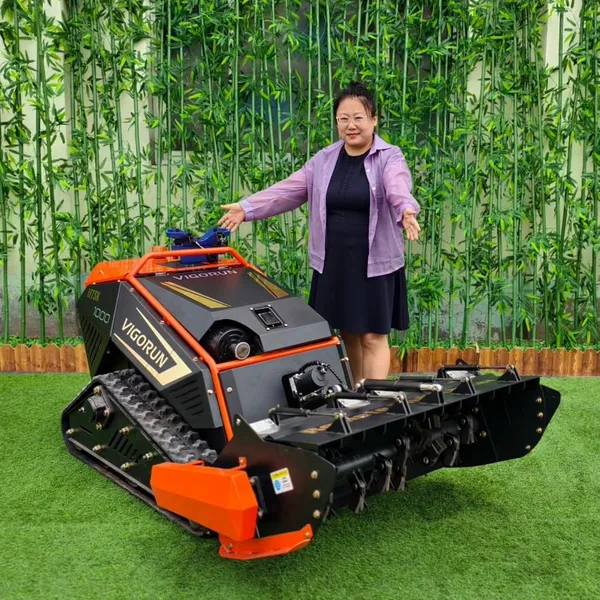
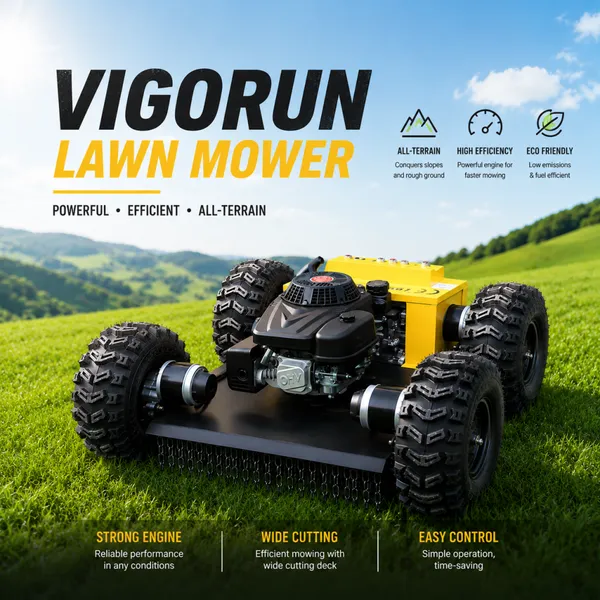
Vigorun VTLM800 Remote Control Electric Mower, Self-Locking Slope Safety Crawler Mower for Steep SlopesUS$ 2600.00 - 2700.00MOQ: 1 Set
-
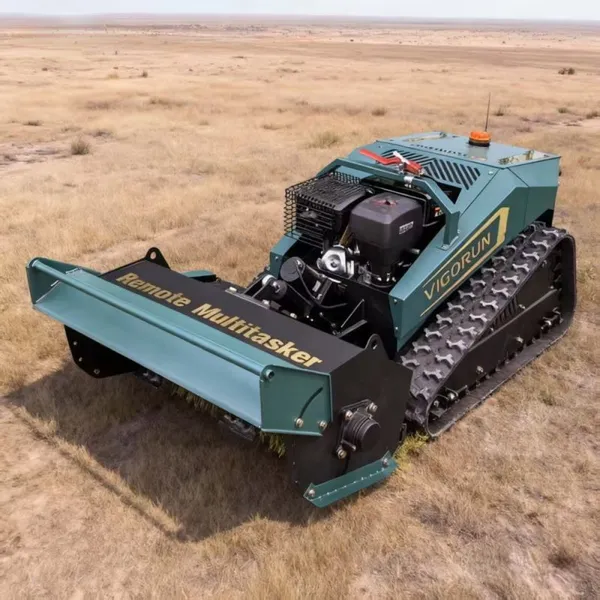
Shrub and Brush Clearing MTSK800 MTSK1000 Flail Mower rc Remote Weeding Weeder MachineUS$ 2800 - 2900MOQ: 1 Set
-
RC Robot Lawn Mower Electric Remote Control Flail Grass Cutter Garden Cutting Machine MTSK1000US$ 8000 - 8200MOQ: 1 Set
-
Remote Manipulation Rubber Track Brush Cutter Industrial Flail Mower for Efficient Shrub ClearingUS$ 2000.00 - 2790.00MOQ: 1 Set
-
Vigorun MTSK1000 Rc Lawn Mower, Loncin 764CC Gasoline Engine Forestry Mulcher With Remote Control for ForestryUS$ 7500.00 - 7700.00MOQ: 1 Set
-
Vigorun VTC550 Zero Turn Electric Mower Quality Guaranteed Crawler Brush Cutter For Embankments & LeveesUS$ 1600 - 1690MOQ: 1 Set